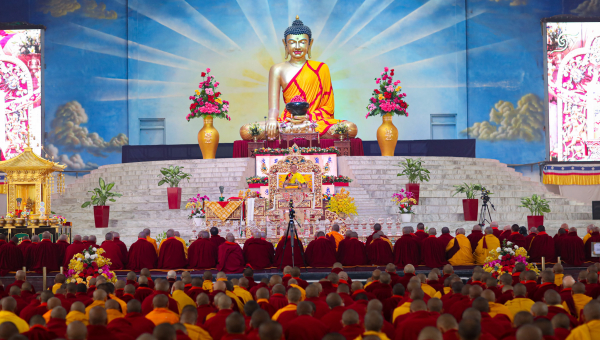
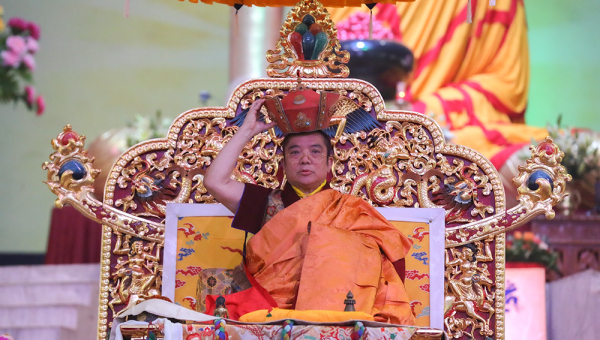
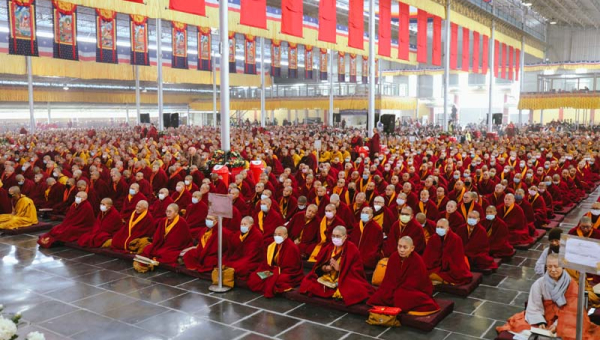
Medicine Buddha
Empowerment
December
25, 2007, Mahabodhi Stupa, Bodhgaya, India, Translated
by Ringu Tulku Rinpoche &
Karma Choephel
In
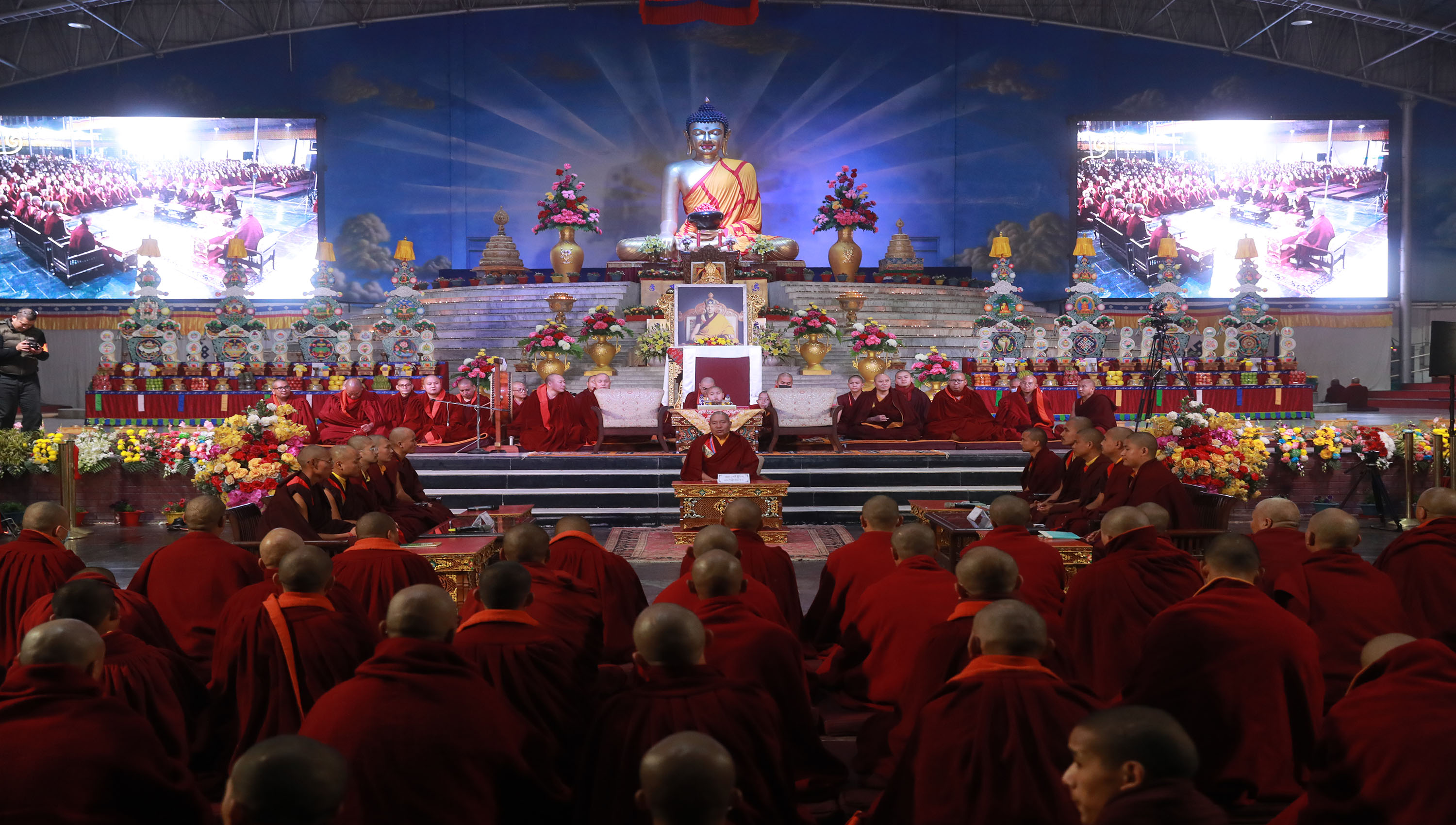
addition to the 25th Kagyu Monlam, we have three days of
the practice, mantra recitation, and feast offerings of
the Medicine Buddha. Today is the first of these days,
so I will give an empowerment connected with the
Medicine Buddha. Tomorrow I will give a short Dharma
teaching on the Medicine Buddha.
The great Chandrakirti said:
When one has freedom and a good situation,
If he does not restrain himself,
He’ll fall into the abyss and lose control.
Who will pull him out of there later?
We have a choice about gaining happiness in this life
and future lives. We have a choice about whether to
follow the genuine Dharma and the path to liberation. We
have this choice this one time; it is difficult to get
it frequently. This is not only the case with the
Dharma. Even in terms of how we lead our lives in this
world, we cannot make things happen the way we want. We
do not have the control or the opportunity, and this
creates many difficulties for us. This is why some
people might want to be good people and do good work but
find themselves in situations where they have no
alternative to doing harmful jobs.
From one perspective, most of us gathered here do not
have that sort of difficulty. However we look at it,
there is an opportunity right before our eyes to do
something virtuous. Whether we take it or not is up to
us. If we wish to take it, we have the opportunity. I
think that doing something virtuous, something
beneficial for sentient beings at this time will make
our human lives meaningful.
We have many difficulties in our lives. There are many
inequalities in this world. Differences between rich and
poor, or male and female, and differences in politics
and resources put a lot of pressure on us and create
many problems. There is no way for us to lead our lives
while ignoring these difficulties. As far as religion,
there are many different religions in the world. All
religions have their own particular way of explaining
their views, which leads them to regard one another with
suspicion. Some are not only suspicious, but feel they
need to make their own religion triumph over others.
Thus it is not easy to live in this world. In both
religious and worldly terms, the world is difficult by
nature. There is no way to avoid having to endure
troubles, no way to live easily and comfortably.
Is the reason there are such difficulties in the world
just that the world itself is a difficult place that is
by nature full of strife? It is not just that. Although
the world is like that, I believe that the way we all
think affects our situations greatly.
In my case, for example, my life is connected with
Dharma and religious practice. From the time I was born
in this world, I have lived in an environment where
people have faith in religion, specifically the Buddhist
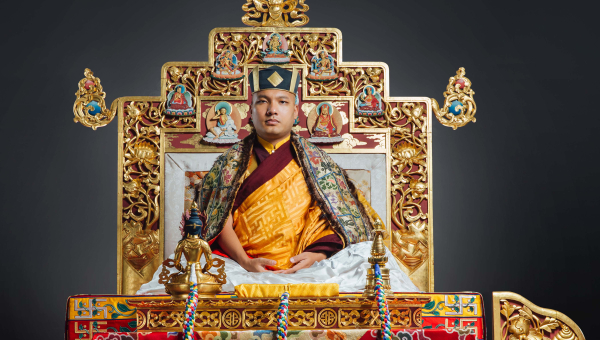
religion. When Apo Gaga, or Ogyen Trinle Dorje, who
spent his early years in a Buddhist environment, goes
through the world and makes contact with different
people and religions, sometimes he encounters
difficulties. What are the difficulties? Since I was
little, I have had Buddhist habits and been committed to
Buddhism. Therefore, I have had to be a bit careful when
meeting people of other religions. This is not because
of how I feel. It is because my responsibilities put me
in a position where I have to be careful. However, there
would be nothing wrong with saying that the Buddhadharma
is an extremely straightforward and open-minded
religion. Now that I have studied the Buddhadharma and
gained a decent understanding of it, I do not think my
leading a dharmic life conflicts with any religion.
In Buddhist terms, the reason is that karma, cause, and
result are most important. The Three Jewels may be
important, but karma, cause, and result are more
powerful than the Three Jewels. My being Buddhist in
this life is the result of a past action. In Buddhist
terms, my Buddhist way of life has come about because of
karma, cause, and result. Since this is just a result of
past actions, there is nothing I can do other than take
it up with joy and enthusiasm.
Most other religions believe in God or a creator of the
world. From this perspective, too, for me to have
Buddhist views and a Buddhist way of life in this
lifetime is harmonious with other religions. In terms of
the beliefs of other religions, it was God who made me,
and it was God who made me become Buddhist. Therefore
there is nothing to do but say, “I take refuge in Him”
and gladly take this on. This is why I sometimes think
that my leading a dharmic life is not in conflict with
any other religion. This way of thinking makes me feel
comfortable and relaxed about leading a dharmic life.
I also have many worldly difficulties. One is not having
any freedom, and then there are difficulties that are
not my own but that other people give me. You all see
this yourselves. Many people come to see me every day.
You might think this is great, but they never tell me
anything good. Most people tell me about their problems:
“Men and women aren’t equal. You need to look into
that.” Or they might say, “There is too great a
difference between the rich and poor. You need to look
into that.” Sometimes when the members of a family are
having trouble getting along, they come and ask me what
to do. If someone needs a minor operation on their ear,
they ask me what to do about that. I have to do a lot of
jobs. The first is doctor. Then I have to do a mother’s
and father’s jobs. There are a lot of different jobs in
the world, and I have to do a significant percentage of
them simultaneously.
People have many problems, and how can I help with them
all? Have I mastered all these different professions?
No, but what can I do? When I meet people with such
trust in me, it would not be right to say something
like, “I don’t know. I don’t care if you are sick,
suffer, or die. Go away.” I have to find some way to
help with these problems. I do not have the resources to
get all the things you might need. I do not have
anything else I can do, and there is nothing I can say,
except that I am doing what I can to take on all of your
problems and remain alive on this earth. All I can do is
give you advice on how to develop strength of heart. The
best thing I can do is help someone develop strength in
their heart.
I always try to have pure feelings of love and affection
from the bottom of my heart for everyone, whether I know
them or not. I try to show this attitude in the way I
present myself and hold my body. When I look at people,
I look with love and affection in my eyes as much as I
can. Even if I can do nothing else, maybe the other
person can find some new strength in their heart and a
new hope. This is what I hope will happen and what
others hope for as well. For some people it happens as
we hope, and for some it does not. That’s the way the
world is: things work out for some people but not for
others. Not everything is spontaneously perfect, and
there is nothing to be done about that.
When we are dealing with the difficult problems of
living in the world and Dharma, the most important thing
is to firmly set our minds on something, whether or not
we also need to rely on outside conditions. We need to
be courageous and use our intelligence well. We need to
develop all our skills and means. If we can do that,
although we may not be able to eliminate birth, aging,
sickness, and death immediately, I think we will be able
to handle our worldly problems. We cannot eliminate
birth, aging, sickness, and death immediately because
our bodies are impermanent things that naturally arise,
remain, and perish. But if we have courage and hope,
eventually we will also be able to liberate ourselves
from birth, aging, sickness, and death.
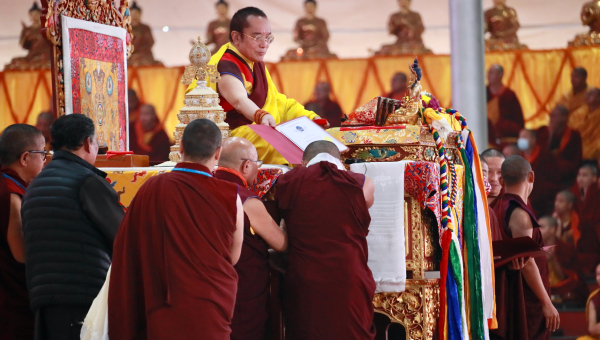
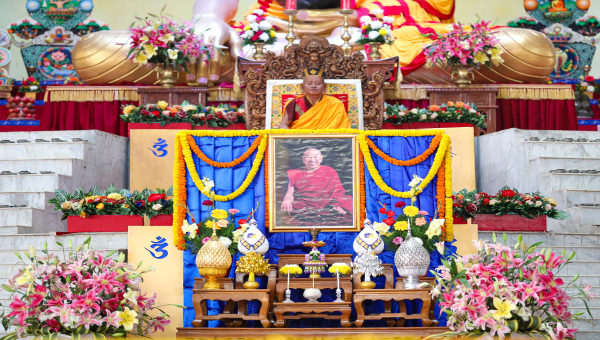
I am bestowing the empowerment of the Medicine Buddha so
that you may receive these benefits—this vigor of the
mind or power of the heart. During the Medicine Buddha
empowerment, just as during the puja, the billionfold
universe becomes the palace Lovely to Behold—a pure
realm as beautiful as beautiful can be, as vast as vast
can be. That is how we visualize the world.
The reason this works is our strength of heart. While we
are living and remaining in this world, if we only pay
attention to darkness and hopelessness, we will not see
anything but darkness. But if we turn our attention
toward light and hopefulness, then even if we have only
a little hope, we will eventually be able to find a way
to reach the light. For this reason, the world
environment and all the beings in it are not all bad.
The beings in the world are not unilaterally vicious,
and the external world is not exclusively poisonous and
polluted. If we make efforts with a courageous heart, we
can transform the world into a pure realm. We can
transform the beings in the world so that they become
the beautiful and majestic deities present within their
minds.
That is why we say that the entire billionfold universe
becomes the palace Lovely to Behold and all the beings
within it become the Medicine Buddha. Otherwise, the
world around us is not really like that, is it? Look
around—we could sweep and mop morning, noon, and night,
but there would still be no end to the filth in the
world. This is not the palace Lovely to Behold. If you
sweep and mop three times a day and there is still
filth, it could not possibly be the palace Lovely to
Behold. Look at the beings in the world. Every day we
see in the news that someone got killed here, someone
else got killed there. It seems more like we have come
to the palace of the King of Death; there are not any
gods and goddesses sitting around smiling, their bodies
swaying in a gentle dance.
This is why Buddhists and practitioners of the Secret
Mantra Vajrayana practice and take empowerments.
Indirectly, this is to give all sentient beings strength
of heart. If we have courage and put some effort into
it, it is not impossible to transform this impure world
into a pure realm; it is not impossible to transform the
beings of this world into gods, goddesses, buddhas, and
bodhisattvas. If we thought this teaching was just for
Buddhists, our intention would probably be too limited.
If that were the case, the Bhagavan Buddha would have
turned the three wheels of Dharma just for Buddhists,
not for all sentient beings. Thus this was actually
taught to Buddhists and Vajrayana practitioners, but
indirectly, it was taught to give all sentient beings
strength of heart.
[Empowerment begins]
This was giving the obstructor torma. In terms of how
things appear relative to one another, it is possible
that obstructors could be something external to us and
separate from us. However, the main obstructor is the
self-cherishing and ego-clinging within us. Sometimes we
do not suppress our ego- clinging or do anything about
it, and instead pretend to be Lama Rinpoche. We sit in
the middle of a protection circle on the vajra ground
surrounded by a vajra tent and say, “OM SUMBHANI
SUMBHANI blah blah . . . ” We think, Isn’t it grand to
be inside this impenetrable protection circle? But this
does not work. To take our fine self with its
ego-clinging and self-cherishing, stick it inside our
hearts, and let it have fun while saying HUNG PHAT to
external obstructors does not help at all. The main
thing we need to say HUNG PHAT to is inside ourselves.
That is what we need to get rid of. It doesn’t help to
pace around the outside of the house when the thief has
already snuck in.
We give obstructor tormas to dispel maras and
obstructors. Since Bodhgaya is the place where our
Teacher the Bhagavan Buddha defeated the forces of Mara,
I do not think there should be too many maras here. It
is like practicing Vajrayana rituals in Lekdrup and such
places where it is said there will not be many
obstacles, so I think there can’t be any maras here. If
there are any here, they must be the nice maras that we
keep inside ourselves. Only when we begin to decrease
the strength of the maras inside ourselves can we make
any plans to help others in a way that is not connected
with selfishness, ego-clinging, or the afflictions. If
we make plans while bristling with ego-clinging and the
afflictions, they will be mixed with ego-clinging and
the afflictions. It would be impossible for them not to
be.
[continues empowerment]
That was asking the master to grant us the King of
Vaidurya Light as our yidam deity. Giving this
empowerment is a different situation than if everyone
gathered here were taking the Medicine Buddha as their
particular yidam deity. I think that this empowerment
was probably supposed to be bestowed upon people who
were taking the Medicine Buddha as their own yidam
deity. These days we give empowerments for hundreds upon
hundreds of deities. We give empowerments for all the
infinite yidam deities, and thus no one knows who their
yidam is or which yidam to practice. This is a big
problem.
It did not used to be like that: you would only take the
empowerment for your particular yidam deity. No one
would say, “This one is important, so I better get the
empowerment. That one is beneficial, so I better get the
empowerment.” Nowadays, we might think, “I have no
money, so I have to get the Jambhala empowerment.” So we
go to some rotund lama who looks a little bit like
Jambhala and request the empowerment. If we hear that
some lama has great activity, we say, “Please give me
the Green Tara empowerment. Please be compassionate to
me. I have a job I need to do, and this would make it go
better.” I wonder whether this might really be a bit
worldly.
Here it is the Medicine Buddha King of Vaidurya Light.
From the time we become human beings, it is important
that we help one another and have affection for one
another. How did our births happen? Our births happened
because our parents loved each other. If they did not
love each other, we would not have been born. It is
because of love and affection that our bodies and
aggregates could come to be, so we all need love and
affection. There are various ways to have affection for
each other.
Humans have various problems, such as the problem of
poor physical health, the problem of being afflicted by
an illness, or the problem of having no happiness in our
minds. These are physical and mental illnesses. It
probably would OK to say that all our problems are
illnesses. External problems that afflict our body,
speech, and mind are probably illnesses. Internal
problems in our minds are also illness.
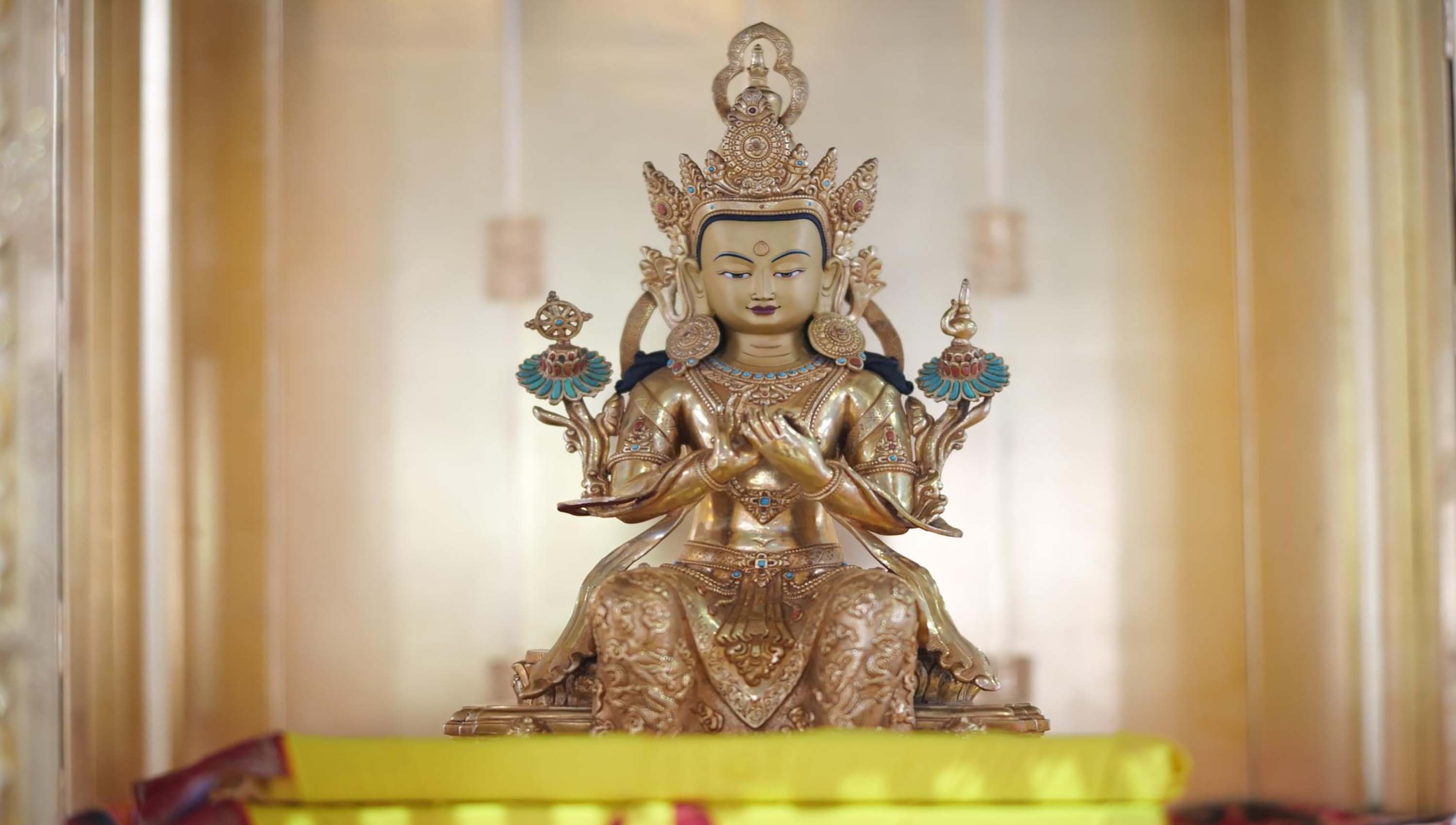
Taking the Medicine Buddha King of Vaidurya Light as our
yidam means that we rely on him to dispel all these
external and internal illnesses. We say, “King of
Vaidurya Light, please always remain above the crown of
my head,” whether that happens or not. The main reason
we call him the Medicine Buddha is that he is closely
connected to medicine. If we help other beings get rid
of their internal and external problems, that is taking
the Medicine Buddha King of Vaidurya Light as our yidam
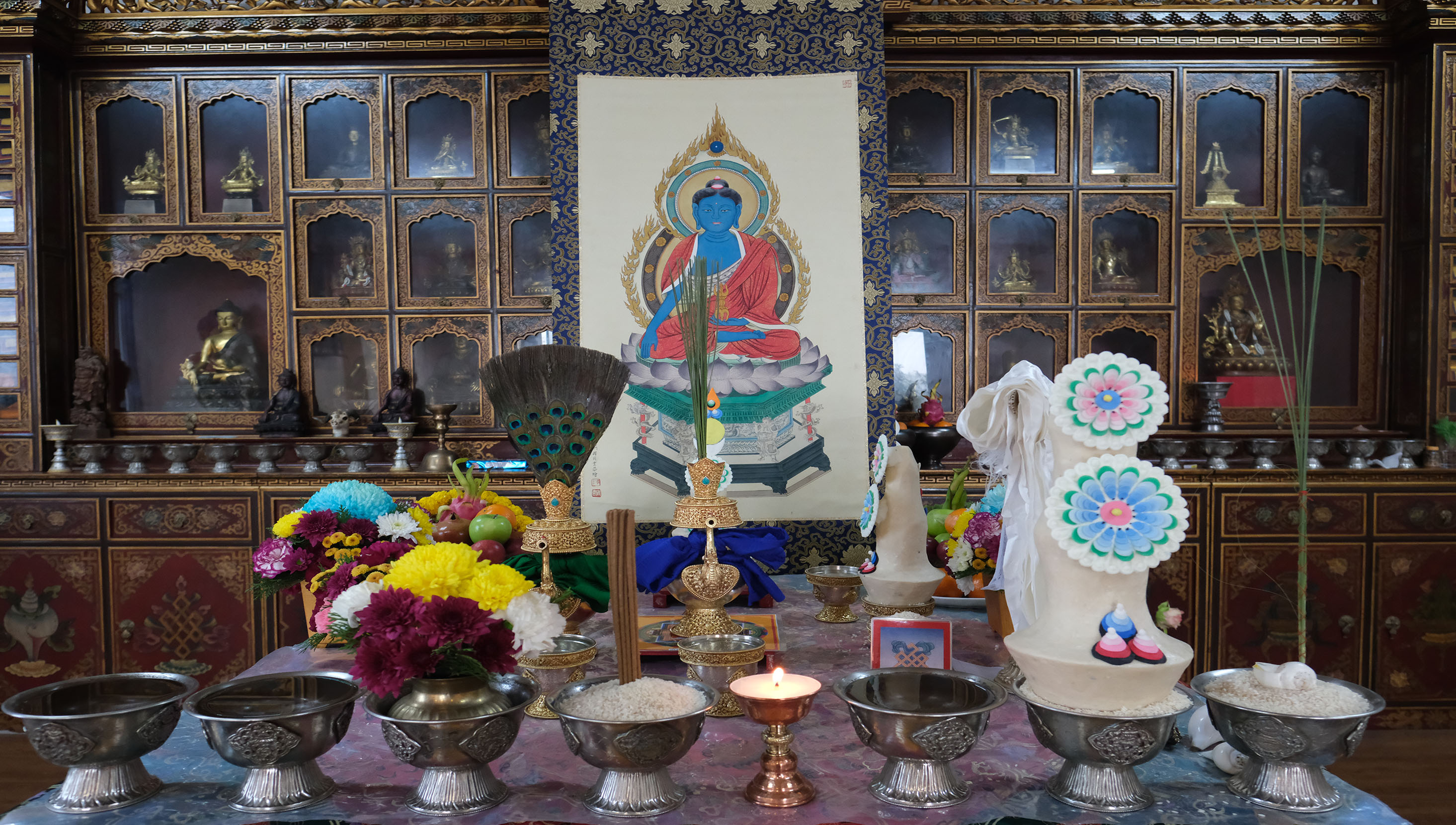
deity. We could put a huge Medicine Buddha thangka in a
back room, pile many volumes of Medicine Buddha
practices before it, and then sit in front of it every
day going blah, blah, blah. Even if we have the entire
Medicine Buddha sutra memorized, if we don’t help anyone
at all and just sit there chanting away while thinking,
“Keep me from getting sick,” I wonder if that is taking
the Medicine Buddha as our yidam. Yidam means to make a
mental commitment. What mental commitment should we
make? For example, there is no point in just saying to
someone, “I won’t forget you. I will keep you in mind.”
It is continuing their activity that is a great wonder.
Now we have come to refuge and bodhichitta. In general,
whatever work we do in our daily lives in the world, we
first have to have trust in the planner who gives us the
work. If they are not worthy of trust and we do not
place our trust in them, then our work will not go well.
So first we need to have trust in a planner who is
worthy of trust. Second, whatever act we are planning to
do, we need to want to take it on and to have trust in
it. Third, we need to have mutual trust in our coworkers
and an outlook similar to theirs. In this way, going for
refuge in the Buddha as the one who teaches the path,
the Dharma as the actual path, and the Sangha as our
companions on the path is similar to our worldly jobs.
We need to have trust in the Teacher, the path the
Teacher taught, and our companions in accomplishing that
path. Even if we are not thinking about religion, this
is necessary.
Bodhichitta is even more important than that. Just
having trust does not help. How much we will be able to
accomplish in our work depends upon how much strength of
intention we have. If we have strong intentions, then
even if we do not have much education or many skills, we
can cover a lot of ground and reap great results. For
example, some people who are extremely wealthy or known
throughout the world do not have much education. Perhaps
at first they did not have many skills and banged their
heads against the wall over and over, but they developed
real strength of heart, attained good results, and
eventually became world famous. This depends upon
intention. This is why refuge and bodhichitta are so
important, not only in our Dharma practice. If we can
bring Dharma practice into our own lives, it will
definitely help us.
Following this is visualizing the torma and the students
as the deity. As I just explained, the world environment
and all the beings in it can be transformed from impure
into pure. But merely being transformable does not help.
Just joining your palms and saying, “May all be pure!”
does not help. If we have a clear vision that we are
going to do something and it will be like this, then the
thought “I am going to do this” comes to our minds. If
instead we just look with big eyes at a statue of the
Buddha or Chenrezig and say, “May it be so! May it
happen!” without thinking about it at all, this does not
help. We need to turn our eyes in toward ourselves and
say, “May it be so!” If we look outward all the time,
the Buddha statue just sits there every day. The ones
who can move are us. Actually, the Buddha is not present
in the world. The Buddha figures in front of us are
unmoving statues; they are symbols that we can look at
and say, “The Buddha is like that.” They can’t do
anything else. We are the ones who can do something. We
can think, remember, and act. Perhaps I am being too
logical, but I will speak directly. It does not help so
much for us, who can think, remember, and act, to stare
at statues that cannot think, act, or remember. I think
it is far more helpful for us to look within ourselves
and develop strength of heart.