More Words on the
Environment
December
27, 2007, 4:30 PM, Translated by
Ringu Tulku Rinpoche & Karma Choephel
We
concluded everything the other day so that it would not
be necessary to say any more today. But some people
wanted me to say a bit more on a few topics. In addition
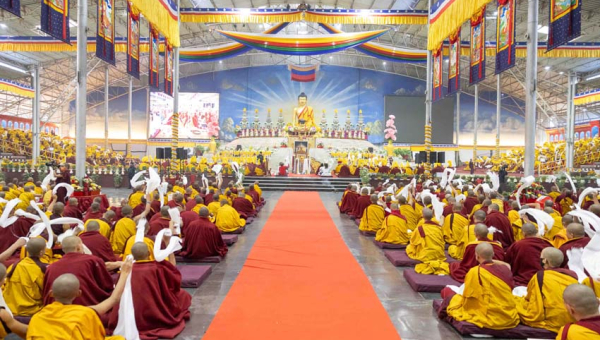
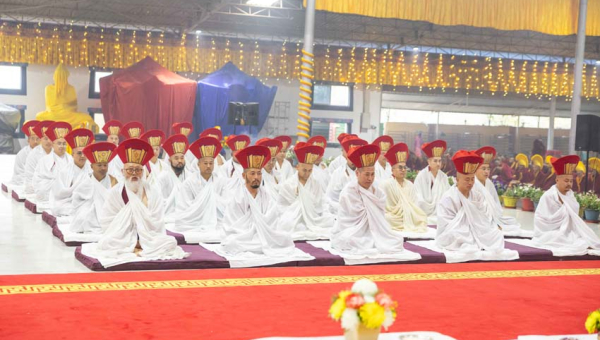
to concluding the Monlam, today we have completed the
practice and mantra recitation of the Medicine Buddha,
so it seems there would be nothing wrong with saying a
few words at this point. I am often a bit glib, so if
you think it is meaningful, please keep these points in
mind. If you do not, you do not have to listen.
The other day, the last day of the Monlam, I spoke on
three topics. The second topic was the environment. I
thought I would say a bit more now about the
environment.
Most of us gathered here today, whether we were born in
Tibet or not, have connections to Tibetan Dharma and
culture and to the Tibetan language. That is the kind of
people we are. Likewise, most of us gathered here live
in and come from India, Nepal, Bhutan, and Sikkim. These
countries are very close to Tibet. For this reason, all
of us who live in these countries need to give some
thought to protecting the environment of Tibet in order
to protect our own environment. This is because most of
the water, especially drinking water, in about eight
Asian countries, including India, comes from Tibet.
Thus, if Tibet’s environment is no longer as clean and
pristine as it used to be, this presents the danger of
great harm to many Asian countries.
In particular, if the water system in Tibet does not
function properly, it will cause many problems such as
floods downstream, like the floods along the Yangtse
River. When these great rivers burst their banks, it
causes tremendous damage. There are floods and many
other dangers. For these reasons the Chinese government
plans to plant many forests in Tibet. India and other
Asian countries are also taking a great interest in the
environment of Tibet because it is such a crucial issue.
Whenever we open our mouths, we say that Tibet belongs
to the Tibetans, but what are we Tibetans doing for
Tibet? Are we protecting Tibet’s environment and keeping
it clean, or are we destroying it instead?
Traditionally, Tibetans have held some ancient beliefs.
If there was an impressive mountain, we would say it was
the residence of some spirit, so it was a revered place
that no one should disturb, nor should it be mined or
quarried. If there was an impressive forest, or a
boulder or cliff with an unusual shape, that was also
some spirit’s residence. This belief was quite helpful.
For example, when I was young, we did not dare go out to
play on the revered mountains where the local deities
lived. Forget about disturbing them—we did not even dare
to walk there. We also were not allowed to put our hands
in the streams that provided drinking water. This was to
keep from polluting them and angering the nagas. If we
had to wash our hands or feet, we had to draw some water
from the stream and wash elsewhere. We were not allowed
to wash, bathe, do laundry, or use any chemicals in the
stream itself under any circumstances. There were
similar traditions more or less everywhere.
But nowadays everyone considers these traditions to be
blind faith. Many people, especially the young, say,
“That’s just blind faith. That’s just religious belief.”
The protection of the environment these traditional
views provided is decreasing drastically. The
traditional way of seeing things is gone, but
contemporary education and views about protecting the
environment are not particularly widespread. The main
focus is economic development and getting rich. That is
what people are into. They wonder whether it is better
to run a factory farm, build huge houses, or buy cars.
That is the thinking that is prevalent.
How are houses built in Tibet? They are built out of
stone and wood rather than concrete. So nowadays, they
use an awful lot of wood to build beautiful,
Tibetan-style houses—a lot more wood than they used to.
In the old days, only the monasteries would have such
carving and decorations; but nowadays many ordinary
people’s houses have fancy carved window and door frames
and so on. At first glance, it is very lovely, but it
wastes a lot of wood and stone. Entire large mountains
are flattened. If all the mountains and forests are used
up, there is greater danger from earthquakes and floods.
There is nothing to hold back or channel floodwaters;
there is nothing to contain earthquakes. Destroying
everything creates a lot of problems.
There is a lot of factory farming for meat. This did not
used to exist in Tibet; it was not necessary. But
nowadays factory farming is easy work. There are factory
farms for hogs, chickens, ducks, and cattle. They give
injections to the thinner sheep or cattle to make them
fatter. This is fine, but indirectly through this, they
have used a lot of steroids. Factory farms are getting
bigger, and the livestock increases. All that livestock
produces a lot of manure and methane, which fouls the
environment. Air that used to be clean and pristine is
now becoming smoggy. We Tibetans have to really think
about all this.
Tibet is on the roof of the world, and it is clean and
pure. It is our own beautiful country. Even if others
cannot protect it, we must keep from ruining it
ourselves. If we take good care of it, we Tibetan people
will not have wasted our honor and responsibility. We
have already lost so much of what we had, and if we
destroy more of what have in our hands, there will be
nothing left that you can call Tibetan. Even if there
were an agreement between Tibet and China, and we could
gain freedom for Tibet, what kind of a homeland would we
return to? We will have ruined our homeland. If we turn
it into a huge, ugly wasteland, gaining freedom will not
help us gain happiness.
One reason all this happens—and it is our own fault—is
that we do not have much interest in education. The more
interest we take in learning about the environment, the
more we will cherish and care for the environment. For
that reason, the Dharma king Songtsen Gampo said:
In the high, pure mountain land encircled by glaciers,
The pure sounds of Sanskrit could be spoken.
You, the people of the Land of Snow
Who have this precious human birth:
I urge you to devote yourselves to learning.
This says that you must become educated. You have a
perfect language, like Sanskrit.
Getting such a good education is like gaining an
excellent language, like Sanskrit. Tibet has an
excellent environment, encircled by snow mountains so
that it is protected from pollution from outside. These
protect both the borders and the environment of this
land perfectly. So this verse says that all those who
have a precious human body there should become educated.
Getting an education is very important. It is all of our
responsibility that everyone become educated and protect
the pure and clean natural environment of Tibet.
As I said earlier, all of us gathered here, whether or
not we were born in Tibet, have connections with Tibetan
culture and language. Thus we all must protect the
environment of the entire world for its future, and in
particular Tibet and the Himalayan range. Tibet is
probably the most important source of drinking water in
the entire world. We really need to consider this.
As I said the other day, we must consider this within
each of our monasteries. I think it would be very good
for any monastery in India, Nepal, or Tibet to get
organized and take an interest in environmental
protection. I am not an expert on environmental issues,
but there are a few points we should know and follow. I
will explain them to you. Please keep them in mind. If
you can practice these in your monasteries and provide
some education in them to the monastics and householders
associated with your monasteries, this will bring
benefit to all of us as communities and individuals.
There are several points. The first is sort of like
child’s play. It concerns automobiles—trucks and cars. I
do not know a lot about this in India, but in Tibet, it
often happens that as soon as a lama completes a
three-year retreat, he absolutely must buy a truck. If
he does not buy a truck and carry around Karma Chakme’s
book on Toh rituals, he is not considered a real lama.
We had a little monk at Tsurphu who had only been a monk
for three or four years, and someone once asked him,
“What do you want to do?”
He replied, “I want to become a lama.”
“What will you do when you are a lama?”
“I'm going do a three-year retreat, buy a truck and
Chakme's Toh book, and then travel.”
He saw lamas doing this. This is what little children
think lamas should do. Every lama buys his own car, and
then they have to buy oil and gas for that car. Oil
comes from underground, but the oil in the world is
being used up, and this creates problems. These days the
price of oil is increasing, and this is causing a lot of
problems, right? This is why we do not need a separate
car for every lama. But now everyone needs the fanciest
cars with the most impressive names—German ones like
BMWs or, in Tibet especially, Japanese cars like
Toyotas—which use the most gasoline. Otherwise they do
not feel like they have the status of a lama.
From one perspective, I have to wonder whether this
meshes with the lives of earlier masters, who are good
examples of having few desires and being satisfied with
what one has. Lamas are Dharma practitioners, whether or
not they are monastics, which means they should be
people with few desires who are content with what they
have. They should not chase after the eight worldly
dharmas of this life directly, although things might
come to them naturally. That is how they should be.
These days it is not like that, and that is a problem.
Sometimes when lamas and monks go abroad, their sponsors
offer them gifts. Sometimes sponsors buy them mobile
phones, and when they do, it has to be the best one.
Monks have even been known to throw away cheap phones
they do not want. I have heard about this happening. If
you pay for it yourself and throw it away, that is one
thing. But if someone spends money to offer you
something, how could it be OK to throw it away? You have
to realize this. If you do not need it, give it to a
friend who does.
We need to rethink whether we should buy so many cars,
especially big cars that use a lot of gas. I do not know
whether this happens in India as well, but if it does,
we should practice restraint, because this is not good,
especially from the local people’s point of view. Most
of us here in India are refugees. If the refugees are
all driving the fanciest cars, the local people will
hardly think of us as refugees; instead they’ll be
jealous that we drive fancier cars than they do. It does
not look good. It is unnecessary. So the first point is
that we need to think about cars.
The second point is that in the remote areas of Tibet,
they are using a lot of solar and wind-powered
electricity. This is good. It is very expensive to
generate electricity, and if we use it without caring
for the environment, it is very destructive to the
environment. Oil-powered generation is especially
expensive.
At Tsurphu monastery, there did not used to be any
electricity, but then they installed solar panels. Solar
panels are still quite expensive, which makes them a bit
difficult to install. It can be very expensive to
provide the amount of power that can cover a large area.
But solar and wind power do not have operating costs,
and they do not harm the environment. They can be quite
beneficial.
In Tibet, the sun shines quite well—it is the roof of
the world—so many people there use solar electricity. In
some areas of North India and Nepal, particularly around
Darjeeling and Mirik, it is always foggy, so you never
see the sun shining, which makes for a few small
difficulties. However, in our monasteries, we are big
groups of people, and we have large electricity
expenses. Since we are already paying for it, we should
think about how to conserve electricity. Do not just
pointlessly leave lights on all the time when the sun is
shining and the weather is bright. I think it would be
good for us to conserve electricity. That is the second
point to keep in mind.
The third point is growing trees, which I mentioned the
other day. We bhikshus are not allowed to cut down trees
or any other plant that has roots and bears fruit. This
is the vast intent of the Lord Buddha. But not only
bhikshus; all of us must keep this in mind. Most of the
oxygen for all the living creatures in this world comes
from trees and plants. So if we can plant even one tree,
it will probably help a great number of creatures
survive. Sometimes I even think it would be better to
plant a single tree than to perform a life-release for
many beings.
Last year I talked about performing life-releases,
giving up eating meat, and becoming vegetarian for the
long lives of His Holiness the Dalai Lama, myself, and
many of our lineage lamas who have become elderly, so
that they might continue to be with us for a long time.
This year I think it would be good for each of our
monasteries to plant a thousand trees, if not more. When
I say plant, this does not mean that it absolutely has
to be done right near the monastery. You can make
connections with groups that plant forests or help
someone who is planting trees. This is for monasteries
that have the resources to do this. If you don’t have
the resources, that is another matter. There are,
however, monasteries that have some wealth and want to
do something for their lama’s long life. My particular
recommendation for this year is that it would be good
for each monastery to plant at least one or two thousand
trees. If monasteries cannot, the monks can plant the
trees themselves. Sponsors would also be most welcome.
Most monks don’t say they have much money, and I don’t
know where they spend what money they do have. It would
probably be quite good if we could make a beautiful
green forest for the benefit of all living creatures,
especially in Tibet.
Tibet covers a huge area, so we could plant as many
trees as we want. If monasteries have to cut trees, then
it would be good for them to plant a greater number than
they cut. Cutting trees without replanting is the one
thing that would anger the local deities and nagas, if
anything would. That is another point.
The fourth point is one that is not our responsibility
as monks. Monks do not farm, right? But when farmers
grow crops, they use various kinds of chemical
fertilizers to make the crops grow quickly. When they do
this, the first crop grows extremely well, but after it
has grown, the soil loses fertility and becomes like
sand, I have heard. The chemical fertilizers exhaust the
soil. This is how it happens.
There are many farms in Tibet. When we plant our crops,
we should not think that this is our own field and we
can do whatever we like. That is one thing to think
about. The other is that the use of chemical fertilizers
is exhausting the fertility of large areas of cropland.
Monks do not need to work in the fields themselves, but
they have many friends and relatives who do. Unless we
use our overall, collective effort, it will be difficult
to protect the environment.
There are several other points, but we do not need to go
through them.
In brief, for the human race, there are two conditions
in this world that can make us advance. The first
condition is to go forward out of fear. All beings,
including animals, will advance out of fear. They sense
a danger to their existence, feel fear and terror, and
find a way to remedy their situation. But I think moving
forward because you see a benefit or profit is probably
something that mainly we humans do. We humans are beings
with brains and intelligence. But while we have these
brains and intelligence, if we just hang out without
doing anything meaningful, then there will be another
mouth to feed, another person using up space, another
body crowding the world. There will be no benefit at
all.
While living in the world, we need to demonstrate
intelligence and define our vision for the future. I
think that only then will our existence in the world be
meaningful. We will no longer just be taking up space.
We will be able to benefit the other creatures who live
with us on this earth.
That is more or less it for the topic of the
environment. If I say too much, the mosquitoes will have
a feast. We have to protect environment . . . but we
should think about whether we need to protect the
mosquitoes.
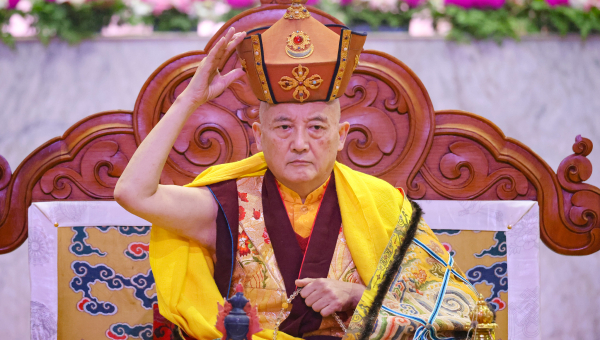
Protecting the earth’s environment is a big issue in the
world now. But that is not why I am shivering on this
throne talking about it.
The Lord Buddha and many of the earlier learned and
realized masters who followed him made prophecies a long
time ago about how the times would become degenerate:
the environment would degenerate, and beings living in
it would also degenerate. These are things the earlier
masters said, but we do not pay attention to them.
People just talk about how it said this here and that
there.
I want to tell you a story. During the upheavals in
Tibet in the 1950s, the previous incarnation of Pawo
Rinpoche was looking through the prophecies of Guru
Rinpoche, and thought, “This probably is going to
happen.” He showed them to his steward and said, “This
is going to happen. These are the prophecies of Guru
Rinpoche. We need to flee into exile; we cannot stay
here.” Whenever he showed these to his steward, the
steward would say, “So it is! I go for refuge!” The
steward would then touch them to his forehead and put
them aside.
Later the situation got worse, and even the Karmapa went
to India. When Pawo Rinpoche heard about that, he said,
“The prophecies predicted this! Even the Karmapa has
gone. We had better go, or what will happen to us?” The
steward replied, “How can that be? There are the three
great monasteries of Sera, Drepung, and Ganden, and the
Tibetan government palace of the Potala. It is not easy
to leave. If you prepare to go, you will ruin any chance
of staying.” He absolutely refused to do anything about
leaving. Either he was not educated or he was complacent
because he had never faced such difficult circumstances.
In the end, the steward was unable to come to India and
suffered terribly. He was sent to reeducation camps
where he was tortured, beaten, and eventually died.
It is similar with us. The Lord Buddha and earlier
masters said a great deal about how we need to protect
the environment, the forests, and the trees. But when we
hear this, we just touch the text to our foreheads and
say, “I go for refuge!” The eloquent and beautiful
words, “May it be so! May there be benefit for all! May
it happen! May this be for all sentient beings
throughout space! May that be!” often pass our lips, but
we do not practice them in a meaningful way. We are
still wandering in the oceans of samsaric suffering
because our wishes and our actions are going in opposite
directions. If we continue in this way, we will remain
in samsara forever. There’s no other benefit. So please
keep this in mind.
That is it. Say the auspicious prayers. It's getting
late.