













Monlam Schedule | General Information for All Participants


The Gyalwang Karmapa’s teachings on Nagarjuna’s Letter to a friend

December 20, 2009, Tergar Monastery, report by Jo Gibson, Michele Martin, photos taken by Karma Lekcho, Karma Norbu


Sunday, 20th December,  2009

report by Jo Gibson


Setting the scene: early morning, Tergar Monastery

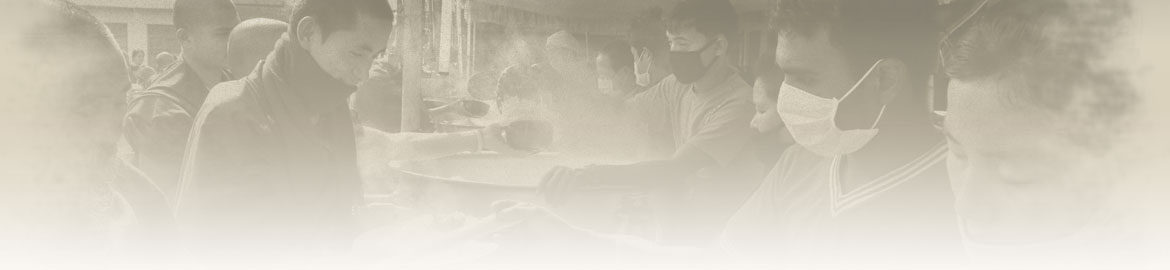
It’s approaching six thirty in the morning; mist and smoke, from early morning fires in the fields and local villages,  drift through the gates and across the grounds of Tergar Monastery. A few Westerners are already circumambulating in the chilly pre-sunrise. Meanwhile, outside the registration booth, a small group of  weary foreigners huddles uncertainly. They are hoping that they will still have the chance to register. All their plans have gone awry and, having  finally arrived  in Bodhgaya a day or more late, they have come directly to Tergar. One group, travelling from Kathmandu, had been in a bus crash. Another’s bus had broken down. Several  had been delayed because of snowbound airports in Euope.  At just turned six thirty, the first of the Teaching Team volunteers arrives, and by seven o’clock the registration booth is open; these early-bird latecomers are issued with badges and cards. In two hours’ time they will be sitting in the assembly hall with 1,500 other people from more than fifty two countries. All the worries and difficulties of the journey will be forgotten.


The Gyalwang Karmapa’s teachings to foreign students on Nagarjuna’s Letter to a friend

Session One : Sunday AM

The following  summary of the morning’s teachings is based on Ringu Trulku Rinpoche’s translation from Tibetan into English, except where the Gyalwang Karmapa spoke directly in English.

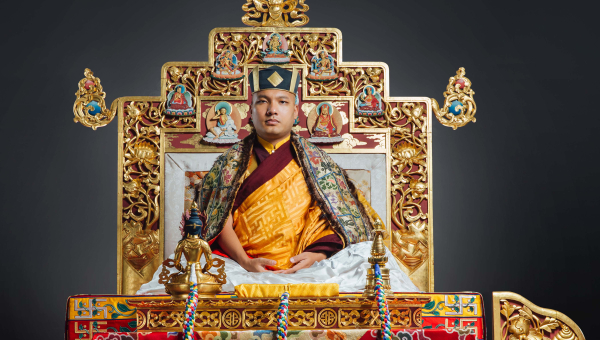
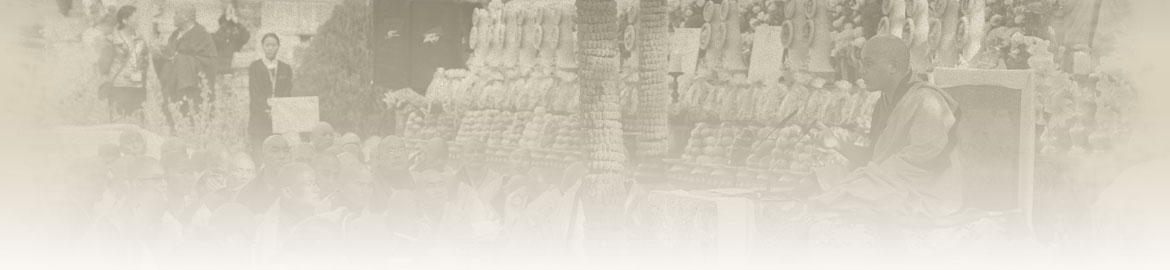
The teachings should have begun promptly at nine o’clock. Gyalwang Karmapa was seated expectantly on his majestically high, intricately carved and gilded throne.  The sound crew was confident. Hours of preparation had gone into setting up the sound system: microphones, speakers, and the FM translation transmission system. At the final dress rehearsal everything had worked perfectly, but now suddenly, it took on  alife of its own and began emitting high-pitched squeals, squeaks and whines.  The audience sat patiently while the sound crew dashed back and forth, fretting over banks of equipment, antennae, cables and microphones. His Holiness smiled, pulled faces, and tentatively tapped his microphone. Finally the problems were resolved, and the teachings were under way.

Having greeted everyone warmly, Gyalwang Karmapa explained why he had chosen this particular text – Nagarjuna’s Letter to a Friend – because, not only did it thoroughly cover the philosophy of Madhyamika, but it was mainly an instruction for householders on how to practice dharma. In ancient India householders who held the five precepts would study the text. It was His Holiness’ hope that this teaching  would provide a new perspective for laystudents on how to be a householder and practice the dharma at the same time.  A  new edition of the text, containing the original Tibetan and translations into Hindi, Chinese, Korean, Spanish, English, French and  German,  had been published specially for the occasion. He pointed out the illustration depicting Nagarjuna on the front cover which he himself had drawn and wryly commented that some people had complained, “The face doesn’t show much character and the body looks like a rock.” He explained that, although he hoped to be able to go through the whole text, there would  not be enough time to cover all the stanzas, so his objective would be to convey the essential meaning, stopping to elaborate on  some points  in detail but glossing over others.

Turning to the text, Gyalwang Karmapa then read and began his commentary  on the first three verses which form an introduction to the teaching and more detailed instructions,  and request people to listen to the teachings.

Stanza One:

Listen now to these few lines of noble song

That I’ve composed for those with many virtues, fit for good,

To help them yearn for merit springing from

The sacred words of He Who’s Gone toBliss.


The Karmapa explained that its author, Nagarjuna,  was a great scholar who, it is said,  lived during the 1st or second century  CE. The main exponent of the Madhyamika  school of Buddhist philosophy,  he wrote Letter to a Friend, a text focussing on the  six paramitas, to his friend, a South Indian king called Surabhibhadra. This is one of the many texts written by him preserved in Tibetan literature, which include several commentaries on sutra, and other important  texts on tantra, demonstrating  that he himself was practising both.   It was he who composed the Mula-madhyamaka-karika which is the foundational text on Madhyamika.  It was  he who brought the Perfection of Wisdom sutras to the Mahayana tradition. There are two accounts of how this happened. One tells how the King of the Nagas gave these  books to Nagarjuna.  The other, found in a Chinese souce,  is from a biography of Nagarjuna written by the great Indian scolar, Kumarajiva, who  travelled to China and translated many Buddhist texts into Chinese.  According to  Kumarajiva,  Nagarjuna had a vision  in which he entered a jewelled palace where he met a great boddhistatva  who showed him many  caskets,  containing sutras which he had never seen before. When he rose from this vision he wrote down what he had read —the 100,000 Stanza Perfection of Wisdom Sutra.

Although the letter was written specifically  for the king it also applies to others as well, including ourselves, commented the Gyalwang  Karmapa. In the first stanza Nagarjuna says that all his instructions come from the sacred words of the Buddha himself and from no other source, and their purpose is to generate the yearning to do the positive. 

Stanza Two:

The wise will always honour and bow down

To Buddha statues, though they’re made of wood;

So too, although these lines of mine be poor,

Do not feel scorn, they teach the Holy Way.


Even if a statue of Buddha is not made of precious materials,  wise  people still honour the image. Similarly, though these instructions were written by a simple monk, the source is the Buddha, so it is worthwhile  listening to them.


Stanza Three;

While you have surely learned and understood

The Mighty Buddha’s many lovely  words,

Is it not that something made of chalk

By moonlight lit shines glowing whiter still.


The text refers to the Great Muni , the one of great capacity who can defeat the kleshas, the afflictions, so Nagarjuna says that even though you may already know the teachings of the Great Sage, it is worth heeding  these verses because a chalk or plastered  building  gleams clearly  and brightly in moonlight.

His Holiness explained that it is important  to know about what we don’t know, but even the things we know have to be  internalised. This is the threefold process of hearing or studying, thinking, and meditating.  Initially we have to study,  applying  our wisdom and our intellect.

Stanza Four:

Six things there are the Buddhas have explained,

And all their virtues you must keep in mind:

The Buddha, Dharma,Sangha, bounteous acts,

And moral laws and gods-each one recall.


The fourth verse introduces the actual instructions, which are organised into three main topics. The first topic is the practice of positive virtues,  the second is understanding the nature of samsara and feeling renunciation,   and the third is seeing  the benefits of liberation. The first general instructions are common to householders and monastics: six things to be mindful of the  Buddha, the   Dharma, the Sangha, ethical behaviour, giving, and deities.

Gyalwang Karmapa stopped momentarily and surveyed the assembly hall, then commented  in English on the fact that the  traditional tea was not being provided during the foreign teachings.

“No tea break, “ he observed, “I hope my words become tea.”

He then began to discuss the meaning  in the Buddhist tradition of taking refuge in the three objects of refuge: Buddha, Dharma and Sangha.

There was a further exchange at this point between the Gyalwang Karmapa and the audience because at the FM transmission stopped working properly and members of the audience were gesticulating  anxiously that they couldn’t hear.

“Can you hear me?” asked the Karmapa, looking down over the audience, who shook their heads.  When he realised that they couldn’t  hear the translations,  he quipped in English,“Is it the FM not working or the mind not working?”  Everyone laughed. He then advised us to try to meditate on patience while the sound crew worked to rectify the problem.

A few minutes later, the teaching resumed and Gyalwang Karmapa continued  his commentary on taking refuge.  He said that generally it can be difficult to differentiate  between Buddhists and non-Buddhists, but  that refuge, if properly understood,  provides a demarcation line. Three things had to be considered:  the person who takes refuge, the objects of the refuge, and the nature of the refuge.  With reference  to the first,  those who go for refuge can be categorised according to the three capacities of beings. Those of small capacity take refuge with the motivation that they do not want to suffer in the lower realms. Those of medium capacity have understood  the nature of samsara as suffering or unsatisfactoriness and wish to liberate themselves. Those of great capacity , because of their immense compassion, are motivated  by the  wish to liberate all sentient beings from samsara.

Earlier, during the Gunchoe teachings His Holiness had raised the question whether those who do not believe in rebirth can be classified as Buddhists. He now returned to this dilemma again, questioning  whether it was possible or meaningful for people who do not believe in rebirth and cyclic existence to take refuge. He was unsure what its function could be for such people.  He also clarified the purpose of  differentiating between people of different capacities.  It  would be  wrong to think in terms of  one being better than another, which might lead us to try to do something beyond our capability. The categories were there to help us. We needed to examine our own mindstate and decide which was the most suitable starting point for us. Then we would be able to make a natural progression, step-by-step, based on our  aspirations  at that point in time. It would also be wrong to look down on others because they had different aspirations.

Moving on to the objects of refuge, the Gyalwang Karmapa first considered  the historical Buddha. Born more than 2500 years ago, a prince who enjoyed a protected life of luxury, he renounced samsara, underwent hardship during six years of meditation, then finally achieved enlightenment. This, he explained,  is the biography of the Buddha as a human being, a bhikkshu  who then became a Buddha. The Tibetan word for Buddha – sangye – has two parts: sang means to awaken from ignorance and gye means vastness in the way that mind or wisdom becomes vast.

At this point Gyalwang Karmapa made a  Hindi/Sanskrit pun .  In Hindi the word  budhu means idiot, but change the spelling slightly and the word becomes buddha Thus we can all become Buddhas from budhus.

The supreme emanation Buddha  revealed  the Four Noble Truths to his five disciples in Sarnath, and at this point  they experienced the true Dharma. The Dharma has two parts: true cessation and true path which means the experience of liberation and the path. Cessation occurs when all karma  is exhausted and negative emotions completely extinguished.  His Holiness  emphasised  that cessation was not to be understood in a nihilistic way, as a form of annihilation, but rather as a completely joyful experience, similar to the feeling of  relief and well-being  we experience  on becoming  completely well after a long, painful illness. The true path is the clear realisation that leads to freedom.

Finally, the third object of refuge, is the noble sangha which means those who have  experience of  cessation and the path.

As to the manner in which we take refuge, there are three things to be considered: our motivation, the depth of our refuge which depends on our motivation, and the level of our faith and devotion.

When we understand and appreciate the suffering of the three realms, the fear of this suffering  propels  us to seek liberation from samsara and pursue enlightenment.  It is important to understand that ‘fear’ here refers not just to being frightened but also includes realizing the disadvantages of samsara. Having seen its negative side, we have the conviction that we must free ourselves from cyclic existence. His Holiness warned that to be ruled only by  fear was the road to madness.  It was also essential to clearly understand that  there should only be fear of samsara;  the objects of refuge should never become a source of fear.  Indeed they are the source of fearlessness. The question of fear also applies to the samaya relationship between guru and student in the Vajrayana tradition. The guru should be viewed as our best friend who will always help us in whatever situation we find ourselves, so, in one way, it is inappropriate to have fear of the guru with regard to breaking samaya.

With regard to faith and devotion, His Holiness observed that though foreign disciples usually go through a process of examining the Buddhist teachings, becoming convinced and then taking refuge, and consequently their faith is based on a clear understanding, there is often a different process at work for Tibetans and those who have been born into Buddhist families.  Such people may not have `gone through this thought process, but may have developed great faith and devotion. However, when we consider faith and devotion, it is crucial to have a  correct understanding of how the objects of refuge  help us; if this is misundertoood,  there may be many  problems. Faith can degenerate into blind faith and superstition. His Holiness illustrated this point effectively and  humourously, giving three examples of blind faith in action. For Buddhists the Buddha embodies compassion,  loving kindness and blessing, but a person of  blind faith may suppose that  the Buddha, out of his great compassion,  will  take care of everything.  Someone who flings their dirty clothes into a corner, thinking the Buddha will wash them, will end up with a pile of dirty laundry. When  crowds of mosquitoes are buzzing around, someone who believes that Buddha will protect them from being bitten, will end up being badly bitten. A school student  who relies on blind faith in Buddha rather than studying hard to pass their exam will get a zero. The Buddha taught the way but then we have to practise it.  The Buddha is in a different world – the pure realm—and  cannot transform us into enlightened beings. We have to do the work ourselves. If you then ask, why do we need the Three Jewels, the answer is that we need to know the way and we need someone to instruct us.  Buddha  shows the way, and we have to follow that path, work hard  ourselves and then there will definitely be a result.   Once we have taken refuge,  we still have to work on ourselves.

Who then are the noble sangha? In the Hinayana sutras it  states  that someone who upholds  ethical discipline,  who has achieved a degree of meditative stabilisation,  has generated some wisdom and is contented, and has  abandoned the afflictions,   can be called one of the noble sangha.  They have entered the path, and if they continue to practise the ten virtuous actions they will attain enlightenment, without a doubt. Because of their qualities,  the ten virtuous actions will continue to grow and increase.

In the end, the final result depends on us.


Session Two : Sunday PM

report by Michele Martin


After offering three bows and prayers, His Holiness continued his teaching on Nagarjuna's Letter to a Friend. in the afternoon of December 20, 2009.


There are benefits that come from bringing to mind the gods who live in the higher realms. In order to arrive at their high status, they needed to develop their practice of peaceful abiding (shamatha), so remembering their achievements can have the positive effect of our becoming more mindful and aware. We can also recall that in order to arrive at a rebirth in a higher realm, the gods had to engage in numerous virtuous actions.  So we should bring to mind how the gods attained their rebirth.  Being a powerful god is the result of positive actions.


His Holiness then read out the Verse Five:


With body, speech, and mind always rely

On wholesome deeds, the tenfold virtuous path.

Avoiding liquor at all costs, thus find

True joy to lead a life of virtuous deeds.


The ten wholesome, or virtuous actions, are to avoid the ten unwholesome or unvirtuous ones.  We should understand why it is important to follow this teaching, for it leads us away from what is not harmonious with Dharma and turns us towards what is.

In the Vinaya, a positive way of life is emphasized through respect for the rules of conduct.  There is a lot say about this, but not much time, so we will focus more on the life of the householder, who develops respect for the Dharma.

First let us look at vows. Taking refuge in the three jewels is the basis for all other vows. Any other kind of Buddhist vow we might take is based on refuge.  If we take refuge, we can become an upasaka (a lay holder of vows).The initial promise we make when taking refuge is not to harm living beings and refrain from violence.  The first practice of Buddhism is not to harm others.  In particular, abstaining from harming is the basis of the Foundational Vehicle. 

Not harming can be understood in terms of avoiding the ten unwholesome actions: the three related to the body (killing, stealing, and sexual misconduct); the four related to speech (lying, harsh words, gossip, and divisive talk); and the three related to the mind (wishing to harm others, envy, and wrong view).   All of these actions injure others.  If we are able to purify our minds, then doing harm to others along with its very basis is eliminated.

The mind is the basis of the first seven unwholesome actions of body and speech, which directly harm others. If the three negative mental actions are not present, then the negative actions of body and speech will not happen. If we eliminate negative actions and the afflictions (klesha) from our mind, we will naturally have a mind that benefits others, because the ten negative actions of the mind stem from the afflictions of hatred, excessive desire, and ignorance. Therefore, giving these up relates directly to not harming others.

Hinayana also speaks of not harming others. Sometimes we may think that the Mahayana is the only path of compassion, but that is not completely true.  The extent of the compassion may differ, as the Mahayana aspiration is for all living beings, but in the Foundational vehicle there is a very strong desire not to harm others.  If we speak only of not harming others, it is difficult to separate the Hinayana from the Mahayana.

Motivation is extremely important.  In the beginning, we may have a good motivation, but if we have not worked on eliminating our negativity, then we could harm others later.  Meditation helps us to work on our afflictions. We can learn to subdue and control our anger, for example, and in general, our minds will become more flexible.  If we do not meditate, we may start with intention to help others, but it is possible that our negativity will return and subvert what we are trying to do, so we could wind up harming others.

According to the Abhidharmakosha, the first seven negative actions (the three of the body  and the four of speech), are karmic actions; the three of mind are not karmic actions, but create the path through which actions happen.

If we commit a negative action, we can make a firm resolution not do it again. Then we can purify the negativity in front of a Dharma support, such as a statue or image of the Buddha.  Our motivation should be so strong that even at the risk of our lives, we would not do it again.

If we take as an example, the negative action of killing, then we can see that it starts with rejection or aversion. At this point, however, the action is not complete, so we have time to stop it. There are many different stages so we can tell ourselves why we should not kill and change our intention.  If you can catch it at this stage, then an action is not complete.  So our intention is the main thing and it allows us to catch a negative action before it happens.

You might think that the three negative actions related to mind happen so quickly that there would be no time to change them. But it is possible.  For example, suppose you really wanted a certain computer.  First you think of computer—how critical it is to your life; how beautiful it is, how useful, and so forth.  You think of all the good things connected with it and you convince yourself that you have to have that very computer. Your life will go well.  You’ll finally be happy. If you don’t have it, you’ll be just miserable. Finally, you think , “I must absolutely have that computer.”  You mind narrows down around this one thing and becomes stuck to it.  So there is a process here and there is time to interrupt it.  First we have the thought related to a negative emotion, then an object for it appears, and finally we do something negative.

We must be mindful, aware, and conscientious, because these patterns repeat themselves.  When problems arise, they provide an occasion for these afflictions to surface.  So we have to apply ourselves again and again to identifying and halting negative thoughts.

Working with our minds is especially important, because the mind is the source of our physical and verbal actions.  If we do not this, then our negative actions become like thieves who steal away our merit and virtues.  If we are involved in any of the ten negative actions, we will accumulate karma.  So our intention to improve ourselves and change is very important.  If we do not have this positive motivation, then transforming ourselves is very difficult. Mindfulness and awareness are arising with every moment and we should try to maintain this continuum and not waver from it because negative actions can be halted by mindfulness.

The third negative action related to the mind is wrong view. In the Abhidharmakosha, it is said that for monastics, it is difficult to avoid wrong view because they are dependent on others:  They beg for food and rely on other people for donations. This may led them to say something in order to receive offerings; they could play the dancing monkey for their sponsors.

For lay people it is difficult to avoid wrong views due to the way that they use divinations (Tibetan, mo). When they encounter difficulties, lay people tend to ask for a mo. They also practice Dzambhala to accumulate wealth or Tara if they are sick. This is not the right way to apply the Dharma, because we are using it to gain worldly benefits.  These are the kinds of mistakes lay people make.

Actually, the Buddha already made an excellent mo for us.  He said that if we engage in virtuous actions, the results will be virtuous; if we engage in negative actions, the results will be negative.  This is very clear.  The most effective mo is to practice virtue. 

In working with negative actions, it is also very helpful to take vows. They give constancy to our actions and provide a counteracting force to our negative tendencies.  They also serve as a basis for awareness.  There are hundreds of ways to take vows.  One way is related to number of people. For example, first we meditate on not killing.  Then we can vow not to injure one person, a group of people, or no one at all. In terms of time, we can take a vow for one day, one month, one year, or until you die.  You could also take a vow not to kill or seal from the Karmapa (laughter).

If someone takes a vow to give up any, some or all of the negative actions, we should praise and encourage them, and also rejoice.  We should all train in avoiding the ten negative actions.

Another way of working with the afflictions is to look into how they come about. We can examine to see: Where did this negative action come from? Where does it stay? Where does it go?


The last two lines of Verse Five state:

Avoiding liquor at all costs, thus find

True joy to lead a life of virtuous deeds. 

This applies to both the lay and ordained sangha.  For those with lay vows, there are negative ways to earn a living, such as selling alcohol, selling poisons, killing others, and selling meat.  However, the main negative actions are all contained with in the ten that we should abandon.  We should also practice the six perfections.  These are very important.

Question and answer:

Question: When we are separated from our root teacher, sometimes we are moved to tears from longing.  Is this crazy?

Answer: Not really. When we recall the positive qualities of our teacher and are moved to tears, that is devotion. It is positive and strong. If you’re oversupplied, perhaps you could pass some along to me (laughter).

Question: How should we understand the eight worldly dharmas or concerns?

Answer: We can understand the eight, (gain and loss, praise and blame, pleasure and pain, fame and infamy), as belonging to three types: white, black, and mixed. The black dharma is a concern only for this life; one looks to benefit oneself and does not think of others. The white dharma is concern for others. The mixed dharma is what most of us have, black and white together.  Genuine Dharma is not just for this life, but for life after life.


 | |


Copyright © Kagyu Monlam Chenmo. All Rights Reserved.