After reading
the biography of Milarepa over the course of three years to
monlam attendees two hours at a time, His Holiness transmitted
the entire life of Milarepa in a single, magnificent evening. In
what was nothing short of a world-class theatrical event,
approximately 20,000 people turned out to view a play of
Milarepa’s life created by His Holiness and performed by actors
from the Tibetan Institute for the Performing Arts (TIPA).
Adding the title of playwright to a list of accomplishments that
already seems impossibly diverse, Gyalwang Karmapa himself
composed the script for the six-act play. Over the past months,
His Holiness has also overseen stage design, rehearsed actors in
his temporary residence in Gyuto and generally provided creative
direction at all stages of the production. According to TIPA,
this was the largest theatrical event in Tibetan history.


A multi-level
stage and massive performance arena were specially constructed
for the play, entirely transforming what was recently a barren
field near Tergar Monastery in Bodhgaya. High-end theatre
technology was imported for the event and put to great effect.
Even before the performance began, the audience burst into
rounds of applause as the stage lighting subtly shifted shades
while the audience slowly filtered into the arena. Multiple
cameras captured the event for projection on massive screens
that flanked the arena, greatly enhancing visibility for the
massive crowd.

The troupe of
over 50 actors and singers travelled from Dharamsala to perform
for the event, held on New Year’s day. The play incorporated
elements of traditional Tibetan opera into a modern theatrical
format, without sacrificing a distinctly Tibetan flavor. In the
interludes between acts, Tibetan monks and nuns chanted Buddhist
prayers, set mostly to melodies composed by His Holiness. The
evening concluded with a rousing series of folk dances from the
three regions of Tibet. Signaling the cultural importance of the
play, Kagyu Member of Parliament Sherab Tharchin opened the
event, and Gyalwang Karmapa himself provided the concluding
remarks. Plans for a DVD of the play are already in progress.

As His Holiness
himself pointed out, the performance of life stories of
important spiritual figures on New Year’s Day is a deep-rooted
Tibetan tradition. While the life of Milarepa has already been
captured in numerous works of Tibetan literature, a number of
features distinguish His Holiness’ production from other
representations of the life of the great Tibetan yogi. On the
most basic level, whereas generally a literary Tibetan is most
commonly used in theatrical performances, His Holiness created a
script in colloquial Tibetan. This renders the play far more
accessible to a general public, and even for audience members
who are highly conversant with literary Tibetan, the shift to a
colloquial register of speech allows for a more intimate and
immediate encounter with Milarepa as a human being.
Additionally,
His Holiness treatment of the character of Kargyen, Milarepa’s
mother, reflected great sympathy for her plight as a mother
rendered powerless in her efforts to care for her children. With
visceral scenes of the physical, verbal and psychological abuse
inflicted on her children by their oppressors, the drama made
clear that Milarepa’s mother had exhausted all other options
before charging Milarepa with the task of learning sorcery to
bring low their enemies. As she sends Mila off to study sorcery,
she tells him, “Other people’s sorcery is the hobby of the rich
and pampered. Our sorcery is the last chance of desperate
people.”


Throughout, His
Holiness made full use of the genre of theatre to bring
Milarepa’s suffering and spiritual transformation to life,
allowing the audience to connect with Milarepa’s in new and
vivid ways. When Milarepa returns to his native land hoping to
see his mother, he learns instead that she has long since died
of a heartbreak, and her neglected corpse was left to rot in
their abandoned home. Finding her weathered bones piled in the
ruins of the house, Mila falls to his knees and tenderly gathers
her bones in his lap. The viewing screens erected throughout the
arena were put to great effect during this scene, as a close-up
shot of the tears streaming down Mila’s grieving face allowed
the audience to share in the depth of Mila’s emotions. At this
point, tears were shed by many audience members as well.


One learned
Tibetan geshe commented that while viewing this play he was
moved to tears on five separate occasions, including the moment
when Milarepa’s mother collapsed in anger when he arrived home
drunk from the classes she had arranged in seeking to give him
an education. Another audience member—not herself a student of
the Gyalwang Karmapa—noted that for her the drama brought
Milarepa to life more vividly and movingly than any of the films
or other performance she had observed thus far.

The drama
offered moments of comic relief as well, much appreciated by the
audience. When Milarepa introduces himself to Marpa as “a great
evildoer from Lato,” Marpa replies: “Maybe you are a great
evildoer. But why are you bragging to me about it? I’m
not the one who made you commit evil deeds. What evils have you
done, anyway?” prompting bursts of laughter from the audience.
A winter chill
further heightened the realism and contributed to the intensity
of audience involvement in the performance as well: As
temperatures dropped steadily during the evening, the character
of Milarepa appeared on the windswept stage, clad in scene after
scene in a thin white cloth, as audience members huddled
together shivering in their jackets and wool shawls. Viewers
were left to reflect on the contrast between Milarepa’s
unflinching mountaintop asceticism and their own responses to
the relatively mild cold of the Bodhgaya night. Meanwhile, the
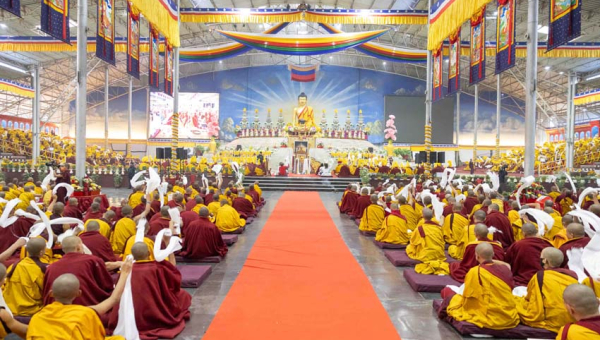
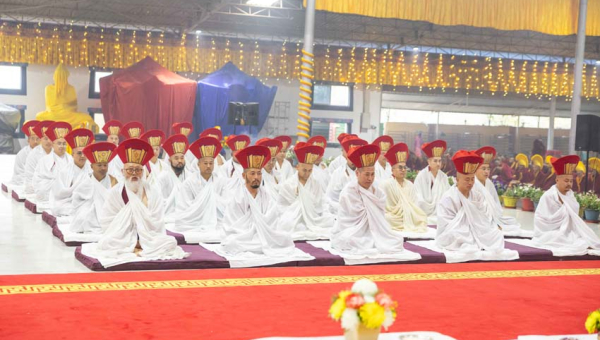
500 bhikshus and bhikshunis seated to either side of the stage
continued to watch intently with right arms bared and shaved
heads exposed to the night air.


During his
concluding comments, His Holiness gazed out upon the many
thousands of audience members for a moment, and then commented
that the benefits of having heard Mila’s life story include
protection from rebirth in the lower realms and liberation.
Gyalwang Karmapa expressed how happy he was that everyone had
come to the play, and with great generosity, thanked the
audience for
their forbearance of the cold.