Monlam Schedule | General Information for All Participants


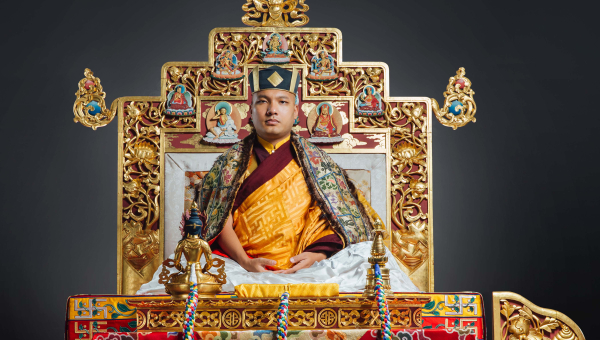
The Gyalwang Karmapa’s teachings on Nagarjuna’s Letter to a friend

December 22, 2009, Tergar Monastery, report by Jo Gibson, Michele Martin, photos taken by Karma Lekcho, Karma Norbu

Day Three:  AM

report by Jo Gibson

The following summary of the morning’s teachings is based on Ringu Trulku Rinpoche’s translation from Tibetan into English.

The Gyalwang Karmapa began by saying that this the third day of the teachings would also be the final session. Consequently it would not be possible to give a detailed commentary on the whole text so he preferred to at least give the reading transmission of it, occasionally commenting, in order that both he and the audience would have a sense of completion.

The next three stanzas, 17, 18, and 19, contain instructions to abandon lowly actions of body, speech and mind.

Stanza 17

Understand your thoughts to be like figures drawn

On water, sandy soil, or carved in stone.

Of these, for tainted thoughts the first’s the best,

While when you long for Dharma, it’s the last.

This verse is concerned with abandoning negative thoughts. The simile compares a drawing on water which is immediately erased, with a drawing on earth which remains for a short while, and a carving on rock which can last for centuries. His Holiness explained that, especially when we first begin to practice, we experience many afflictions in our minds. Thus, we should train our minds so that these afflictions become like words on water.  When, on the other hand, we train in positive qualities such as loving kindness and compassion and so forth,  the results  should be like rock carvings, at best, or, at least,  as if  drawn  on the earth.

Stanza 18

Three kinds of speech are used by humankind,

And these the Victor variously described:

Like honey, sweet; like flowers, true; like filth,

Improper speech—the last of these eschew.

This verse describes three different types of speech – helpful and beneficial which is sweet like honey; truthful   and beautiful like a flower; the last is wrong speech, unclean like dirt, and refers to such things as lies and divisive speech, which should be avoided.

Stanza 19

Some there are who go from light to light,

And some whose end from dark is darkness still,

While some from light to dark, or dark to light

End up, thus four, of these be as the first.

Verse 19 explains why we should stop non-virtuous actions and train in positive qualities. Our ultimate aim is enlightenment, but in cyclic existence negative emotions influence our actions, and our actions harm others.  If we turn away from these non-virtuous actions and work on positive deeds instead, our lives now will become happier and there will our rebirths will also be more fortunate.  Gyalwang Karmapa quoted from Shantideva’s  The Way of the Bodhisattva  “If you ride the horse of bodhichitta you will go from one happy place to another. So how could a bodhisattva ever be lazy?”    Of the four possible directions we can take in samsara, he advised, we should aim to go from light to light, to turn ‘good’ into ‘better’.

His Holiness then read verses 20 to 29, pausing to comment on verse 29.


Stanza 29

You who know the world, take gain and loss,

Of bliss and pain, or kind words and abuse,

Of praise and blame—these eight mundane concerns—

Make them the same and don’t disturb your mind.

This verse refers to the eight worldly concerns and the problems that can arise if we depend too much on external conditions for our happiness and well-being.  This leads to an imbalance in our lives and our mental states become like waves on the ocean. For instance, some people when praised become overjoyed, but then when they are criticised they become sad and depressed. Consequently they have no stability. If, instead, we can be content with whatever conditions we face, we will always be happy.   His Holiness warned that Dharma practitioners should not pay too much attention to what people are saying about their practice. He advised that if we can maintain internal stability and equanimity, irrespective of what is happening externally, life becomes trouble-free.  As practitioners we should understand and accept the nature of samsara. The definition given of samsara is ‘not everything goes well’, so why should we be surprised when things go wrong?   If you put your hand in hot water you will be scalded. You shouldn’t be shocked by this – it’s how things are. If you take a bath in icy water, you aren’t surprised that it’s freezing cold!  Our view of samsara should be similar – we should be expecting problems and not be thrown off balance by them.

 Gyalwang Karmapa went on to suggest ways in which it was possible to maintain mental equipoise in daily life. The Abhidharma lists five ever-present mental factors, one of which is samadhi- a one-pointed factor of stability. Speaking from his own experience he said how sometimes he was so busy that when he reviewed the day at night, he failed to recall anything useful that he had done and felt that the day had lacked purpose and that this precious human life was being wasted.   His Holiness then moved on to consider what it really means to waste time.  The essential thing, he advised, was to maintain a stable awareness in whatever we are doing, and if we can do this we will never be wasting time. There was no point fretting over time spent brushing our teeth, sitting in a traffic jam, or standing in a check-out queue. These were merely external conditions. We always have a choice, whatever we are doing; we can always make use of our minds.  Some people misguidedly believe that their happiness and well-being depend on external conditions such as acquiring a new car, but, a careful examination will show that happiness depends on internal not external factors. If we understand this, whatever is happening around us, we can work on our minds and use that time in a positive and meaningful way. It is fundamentally important to understand that happiness comes from within.

Gyalwang Karmapa then gave the reading transmission of verses 30 – 57. He paused again at verse 58, to discuss the correct understanding of impermanence.

Stanza 58

It’s all impermanent, devoid of self,

So if you’re not to stay there refugeless

And helpless, drag your mind away, O King,

From plaintainlike samsara, which has no core.

Observing that some people became fearful when they meditate on impermanence, he commented that this was not the point; it is not intended to bring fear. As Buddhists we believe that this birth is but one of a succession, a cycle of birth and death. However, people often mistakenly think in terms only of this life—one birth, one life, one death. As a consequence, death becomes uncertain and frightening. The correct way to look at impermanence, however, is as a sequence of births and deaths which we can see operating at all levels of our everyday lives.  Moment by moment, new things come into being, that is birth, and other things come to an end, that is death.  Understanding impermanence in this way should have two positive effects: firstly, it should reduce our fear of death itself, and secondly it should heighten our appreciation of our moment-to-moment existence leading us to value and focus on each moment. If we fail to do the latter, we may waste our lives. If we take each moment as a drop, we can make our lives an ocean of happiness.

Gyalwang Karmapa resumed his reading of the text and completed the reading transmission.


Question and answer session

Q. Should not some Rinpoches have the aspiration to take rebirth as females, as Tara did, in order to show that women are capable of enlightenment?

Having suggested that this was worth praying for, His Holiness commented that  In Tantra it is clear that one can attain Buddhahood in the body of a woman.  A Buddha can emanate in any form – male or female—hence Tara,  but it would be wrong to think in terms of a competition between men and women. There needs to be a reason such as compassionate action for the benefit of women requiring birth as a woman.  It doesn’t have to be a Rinpoche, His Holiness observed, some of the audience  could do it too.

Q.There are so many bhikkshunis here – but none from the Tibetan tradition. When will Your Holiness start gelongma ordination? If Your Holiness does not start the tradition, who will?

Gyalwang Karmapa explained that during the recent Vinaya Conference, there had been a great deal of discussion on the issue of gelongma  (Skt. Bhikkshuni) ordination and how it could be introduced into the Tibetan tradition. There were several difficulties which needed to be thoroughly discussed, as it would be wrong  to act hastily. One difficulty was that there were no  gelongma in the  Mulasarvastivadin tradition, which Tibetan Buddhism follows, although it seems that some Tibetan masters in the past may have ordained nuns.  A second was finding a method  by which the gelongma ordination could be introduced so that its future was stable. Possible solutions discussed at the conference included carrying out gelongma ordination  by a sangha of monks only, or  by a combined sangha of monks from the  Mulasarvastivadin  tradition and nuns from the Chinese  Dharmagupta  tradition. It was difficult to know at what point gelongma ordination would become possible but His Holiness promised that he was working hard on the issue, with pure motivation. It could not be done hastily. It had to be done properly in order to secure the future of the gelongma.

“Don’t worry.  I will do it,” he said in English. “Be patient.”

Q. What is the right way of life for a nun who is working in a hospital far from other sangha members?

For a getsulma (novice nun), His Holiness advised, the most important thing from the Vinaya point of view, is keeping the four root vows, and not doing something  which lay people would take offense at in terms of making them lose their respect for or faith in the sangha.

Q. How should we meditate on selflessness? And how does this relate to helping sentient beings?

His Holiness commented that although we often think of ourselves  as separate and  independent , a closer examination of our situation proves that we are not.  From the very air we breathe which sustains our life, to the food we eat and the books we read, we are dependent on others.  We are a part of everything around us, and compassionate action is a product of a thorough understanding of this interdependence.  From his own experience, he observed, the more he  understood  interdependence  the more he understood how important others were, and the importance of working for their benefit. Usually we think I exist, so others exist, he said. We need to understand  that I exist because others exist.  If others didn’t exist, I wouldn’t exist.

Understanding selflessness and emptiness is basic to understanding  compassion too, he said. Sometimes when meditating on selflessness it seems  as if all becomes nothing,  but when one really understands selflessness, compassion also arises.

This concluded the teaching. Gyalwang Karmapa thanked everybody for coming . Hundreds of years ago the friendship between Nagarjuna and King Surabhibhadra had produced this text, and now, because of the text,  everyone at the teaching had  formed  a karmic connection, and he would pray to ensure that  this connection would be renewed in future. He hoped that everyone would carry the experience of friendship, love and harmony they had shared  back to their own countries, East and West.


Day Three:  PM

report by Michele Martin 

The Closing Ceremony


After three days of inspiring teaching, His Holiness brought to a close his discussion of Nagarjuna’s Letter to a Friend with thanks to the students who had gathered for so far away.

He said, “I am happy to have been able to give teachings on this text and thank you for giving me this opportunity. Letter to a Friend was composed over a thousand years ago when the great scholar Nagaruna sent a letter to his dear friend, King Decho Zangpo. I am very happy to have been able to speak about this text to faithful students from the East and West. The fact that we could all meet here is due to our gathering considerable merit in the past. I sincerely hope that in the future we will be able to meet again and again. I am continually doing as much as I can to make this possible.”

As thanks to His Holiness for these special teachings and with prayers for his very long life, leaders from Dharma centers and the organizers offered him the supports of body, speech, mind, qualities and, activities. Then Lama Chokyi from France spoke for everyone when he compared His Holiness to a skilled gardener.  In the beginning, the seeds are rather colorless and not very attractive, but the gardener knows that with care they will grow into beautiful flowers, so he nurtures them as they grow to maturity. Likewise, in the beginning, we students are rather undeveloped, but with His Holiness’s compassion and teachings, we hope to blossom into true flowers of the Dharma.

Afterward, Michele Martin with Pi Chun Chen translating into Chinese offered thanks to all the many volunteers who made this event possible.  She said, “We have often heard that everything arises through dependent origination.  And these teachings are no exception.  They are due to the auspicious gathering of a whole range of causes and conditions.  We would now like to thank and offer our gratitude to some of the main and obvious ones.” Beginning with His Holiness’ General Secretary, Drupon Rinpoche, and continuing through the people on security, Tergar Monastery, the Kagyu Monlam Administration, Jeff Chen for the website and registration along with a group of 60 Taiwanese; Karma Yeshe for all aspects of electronics; Norbu, Mr. Shi, Jack Rosa and Chopin for the website and sound; the translators into nine languages, and Ngodup Tsering; Ani Renzhan, Ani Renju and the reporters for registration and website; the chant masters Khenpo Sherap and Karma Choephel; Khenpo Tengye and the Hua Yen Foundation for the book of Letter to a Friend in 8 languages; those working in registration; Drolma for keeping our environment clean and pleasant, and John Barhnill for medical services.

Finally, thanks were extended to all who came, more than 1,500, from 52 different countries. Michele continued: “We have done our best to make this a special experience for you and ask for forgiveness for anything that was inadequate or a problem. You have been a wonderful audience and we hope that you will take home fine memories of you time here and a deepening connection with the Dharma. And we hope that you will share the teachings with others when you return home. The practice and spreading of the genuine Dharma is the best offering we can make to His Holiness. We all make the aspiration that we will meet again and have the precious opportunity to hear His Holiness teach for immeasurable numbers of years. Thank you all.”

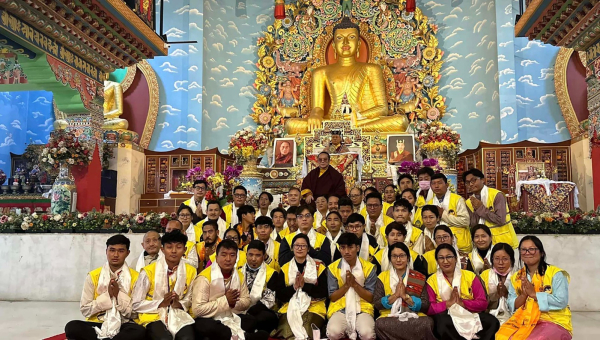
Afterward, everyone had the opportunity to offer their auspicious scarves and personal thanks to His Holiness and receive his blessing.  Many stayed behind in the surrounding gardens of Tergar Monastery to enjoy the sunny, warm weather, to circumambulate the shrine building where His Holiness stays, remaining a little longer in his presence.


 | |


Copyright © Kagyu Monlam Chenmo. All Rights Reserved.