Gyalwang Karmapa’s
Teaching on The Life of Milarepa
December
24,
2009,
Mahabodhi Temple,
Bodhgaya, report by
Jo Gibson, photos taken by
Karma Lekcho,
Karma Norbu, Pema Orser Dorje
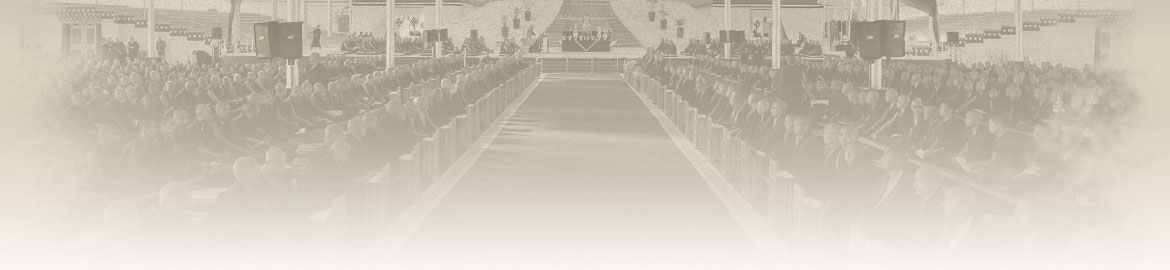
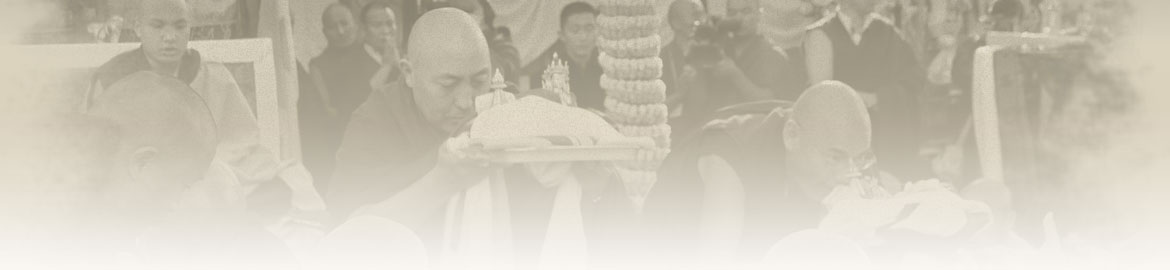
The second session of the first day began with a
mandala offering to His Holiness, after which he resumed the oral
transmission of The Life of Milarepa beginning at Chapter
Seven, which is titled “Meditation”.

In Chapter Seven, in response to a question from
his disciple Rechungpa, Milarepa describes the hardships that he
underwent when he went on a meditation retreat in the mountains for
several months. He took a sack of tsampa and dried meat with
him, meditated for several months and then his provisions ran out.
He was loathe to curtail his meditation practice so he decided to
beg meat from local nomads and grain from farmers in the valley.
At the nomad encampment he encountered his aunt,
his father's sister, the one who with his uncle, his father's
brother, had cheated him and his family out of
their inheritance after the death of his father. When she recognised him she was incensed; she cursed and abused him, and beat
him almost to death with a tent pole.
Milarepa responded with a song in which he
reminded her of what she and her husband did, and the terrible
consequences for his mother “ killed by the sword of poverty” and
his sister “wandering to the ends of the earth” . This led to
“sadness and bitterness” and “intolerable grief”. However, he
acknowledged that it was this experience which turned his mind to
the Dharma. After hearing Milarepa’s song, his aunt felt great shame
and she and the other nomads gave him food and alms.
Milarepa then went to beg from the peasant
farmers in the valley, and encountered his uncle, who abused him,
threw stones, and then shot arrows at him and summoned the
villagers. When some of the young men began throwing stones at him
too, Milarepa decided to use black magic, and called on his guardian
deities. Terrified, the villagers relented, begged forgiveness and
made offerings, all except Milarepa’s uncle.

The next section of the chapter recounts a
conversation about genuine Dharma practice with Zessay, his
former fiancee.
There is a question mark hanging over the future
of the family house and field. Milarepa had no use for it and
offered it to Zessay, but she declined. When his cunning aunt heard
of it, she came to visit him, full of apologies and bearing
tsampa,dried meat and chang (Tibetan beer). She promised to
provide him with food in return for the right to cultivate the
field, however she only kept her promise for two months. Then she
claimed that people were frightened of Milarepa’s guardian deities
and Milarepa agreed to take an oath in order to make her happy.
The story moves on to his meditation experiences.
He found himself unable to practice tummo , the
heat-generating meditation. Finally he had a dream in which Marpa
appeared to him and encouraged him to plough his field, and
immediately an abundant harvest sprang up. He realised that the
dream meant he would be successful if he continued with his
meditation practice.
He moved to a different area. Once more his aunt
appeared, bringing him clothing and provisons, which she offered as
the price of the field. She lied, saying that the villagers, afraid
of Milarepa’s black magic powers, were threatening to kill her and
her husband, and urged Milarepa to go far away. Realising that his
Dharma practice meant he had no need of the field or the house,
Milarepa gave them to his aunt who was overjoyed. Disturbed by this,
Milarepa moved to Horse Tooth White Rock in order to continue his
meditation practice, and vowed not to return to an inhabited place.
Milarepa resumed his meditation, but the problems
persisted until a group of women, who told him Marpa had sent them,
instructed him in yogic practices. Thus, finally, he accomplished
tummo. Another year of meditation practice passed. He
remembered the instruction to meditate rather than sleep, and began
meditating night and day, and another three years passed. His desire
to reach enlightenment was so great that, even when his food ran
out, he refused to break his vow in order to go to the village. He
ate nettles instead.
“Sustaining myself with nettles, I continued my
meditation. Because I had no clothes on my body and no other
nourishment whatsoever, my body, covered with greyish hair, became
like a skeleton and my skin turned the colour of nettles.”
In his commentary on this the first part of
Chapter Seven, Gyalwang Karmapa said that the main point in the
story is what it means to practise the genuine dharma. It reflects
what is said in Shantideva’s Bodhisattva’s Way of Life, that
if there is no suffering, there is no incentive to turn the mind to
Dharma. Milarepa suffered greatly. His aunt robbed him of all his
possessions, he used black magic and killed people, then he deeply
regretted what he had done and his mental suffering drove him to
renounce samsara and practise the Dharma. He studied with great
masters and received the complete instructions on how to become
enlightened in one lifetime.
Without genuine renunciation of samsara and
commitment to working for enlightenment, we will not be able to
practice genuine Dharma and abandon worldly dharmas. Milarepa was a
renunciate; he became like a wild animal. He lived in a cave, forgot
about food and clothing, and concentrated on dharma practice. If
monks and nuns dedicate their body, speech and mind to the
dharma, keep pure ethical discipline, working for benefactors and
sponsors, their lives will be meaningful.
Gyalwang Karmapa referred to Milarepa’s Song
of Promises and Prayers
This song advises us to practise calm-abiding
meditation (samatha) and insight meditation (vipassana) together.In
addition we need to rely on the instructions of a teacher. Our
afflictions are defeated by samatha but the root has to be excised
through vipassana. Then our mind will become stable like Mt Meru,
pliable and under our control, so that we can use it in a positive
way, and we are not overwhelmed by the afflictions. Insight
meditation is the antidote to the root cause of the afflictions,
whereas calm abiding shows us the nature of the mind. In Vajrayana,
His Holiness explained, we talk of samatha as accumulation stage
and vipassana as completion stage.
We should try to generate bodhichitta, working
diligently at developing it, and also work to overcome any
difficulties that we encounter. It is said, he commented, that it is
easy to reflect on Dharma when you have plenty to eat. In fact, we
just feel sleepy. In our own practice at home, we should think
about compassion and love. Sometimes it is hard – an affliction
arises – and, when we encounter problems, it is difficult to use the
dharma in our lives. However, we must always guard our body speech
and mind. This is the practice of Dharma. Otherwise, in the form of
a dharma practitioner, we might be practising non-dharma!
The great Khadampa masters had a method to keep a
check on each day – the count of positive and negative. They used to
use black and white pebbles for positive and negative thoughts. At
the end of the day they could see which one was more. This was
practise with aspiration and seriousness.
His Holiness pointed out that in the very place
where the Buddha woke up from ignorance we should not go to sleep.
Rather we should turn our mind to the Dharma and use this place to
work hard and practise.
This section concluded with the assembly singing
Milarepa’s song:
Prayer of Solemn Commitment
Lord Naropa's lineage son of the freedom path
Please bless this beggar to stay in mountain retreats
With the demon of worldly distraction not distracting
May
meditative concentration grow
Without getting caught in attachment to shamatha's pool
May
vipashyana's flowers burst into open bloom
With elaboration's stress and strain not stirring
May
the foliage of simplicity spread its leaves
With no germ of double mind in my retreat
May
the fruit - experience and realization - mature
With the demon family powerless to obstruct
May
I gain final certainty understanding my mind
On
the path of skillful means uncurbed by doubts
May
the son find a way to follow in his father's footsteps
Compassionate master, the essence of Akshobhya
Please bless this beggar to stay in mountain retreats
His Holiness then led the assembly in a short five-minute breathing
meditation, resting the awareness on the breath.