



























Dharma Talks of Düsum Khyenpa • Day One
27 December 2025
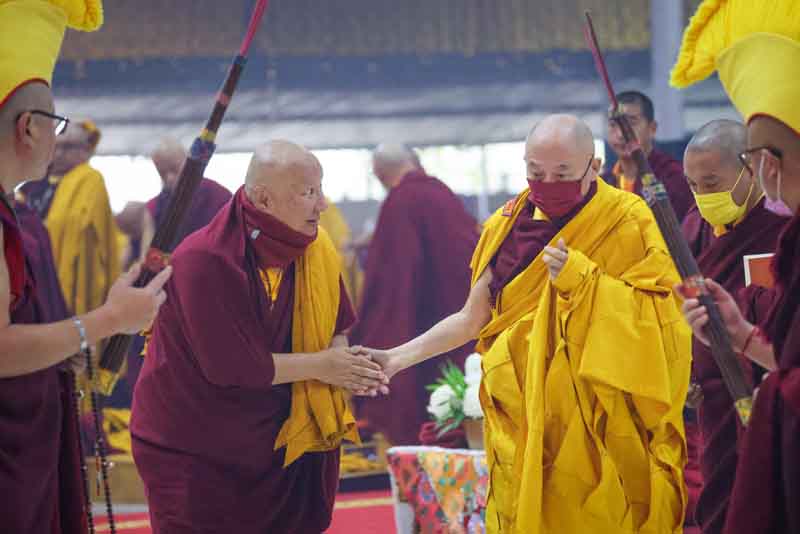
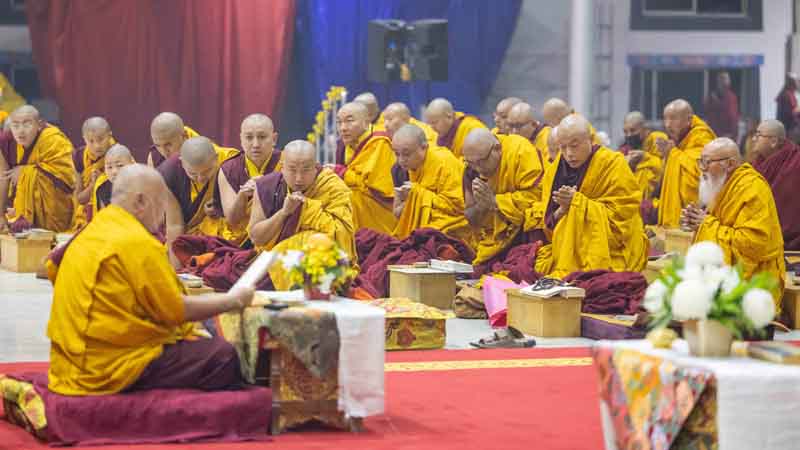
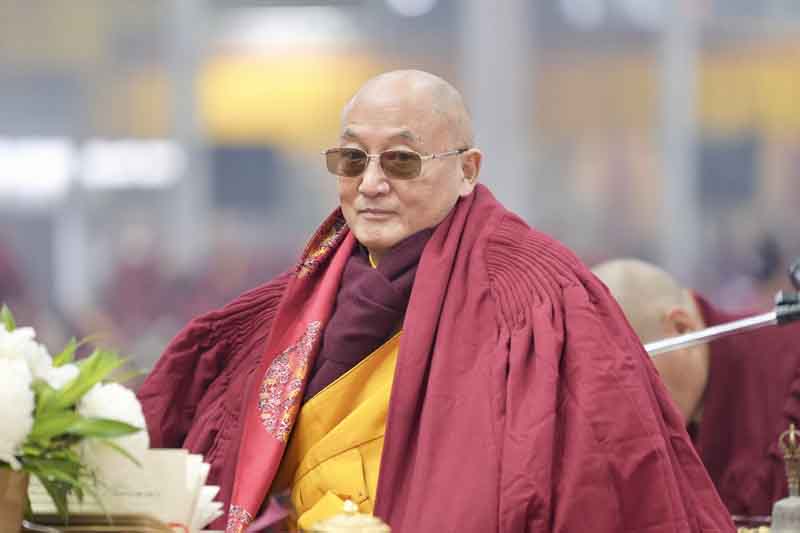
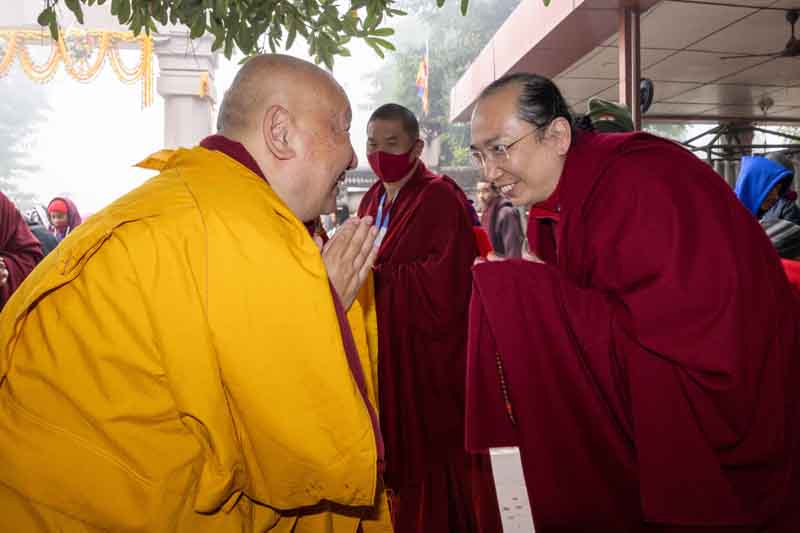
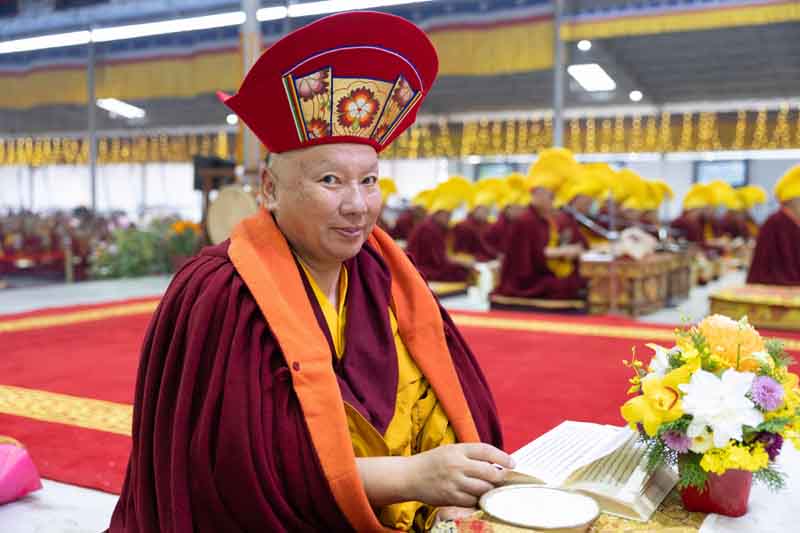
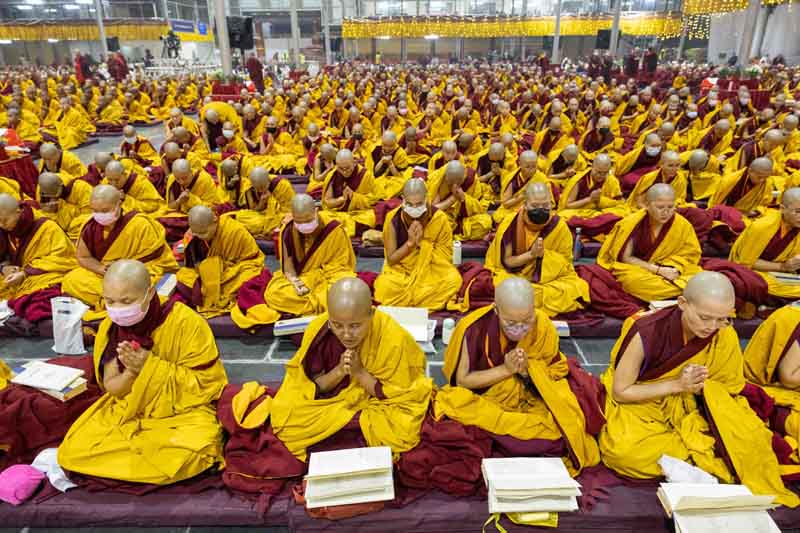
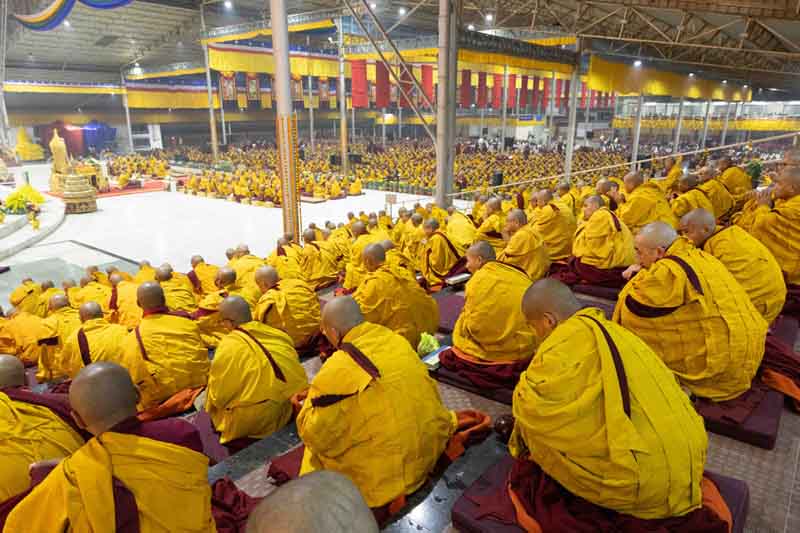
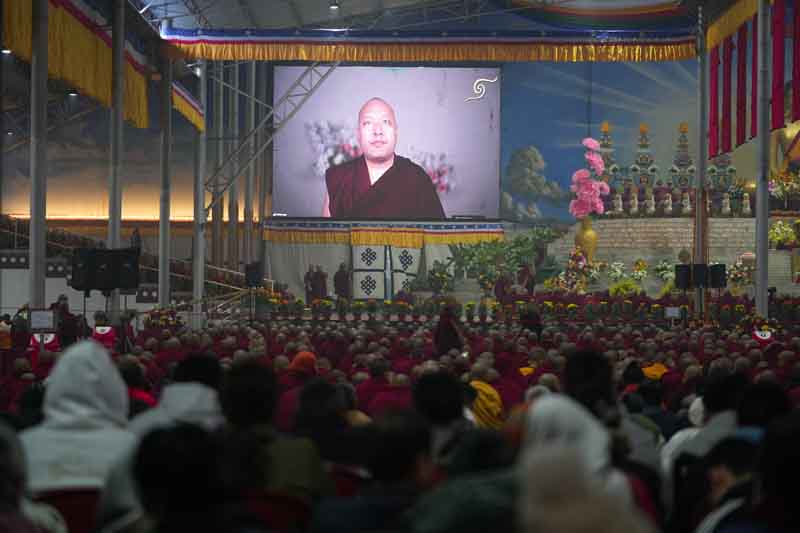
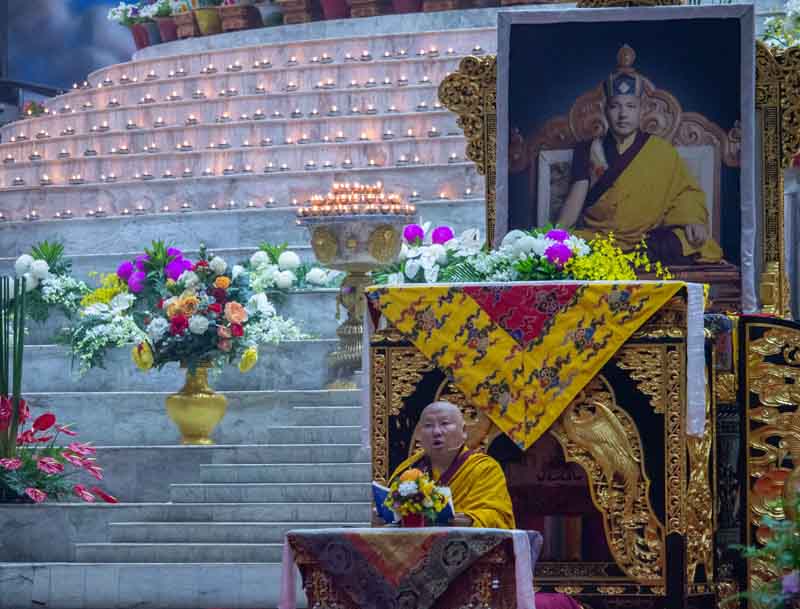
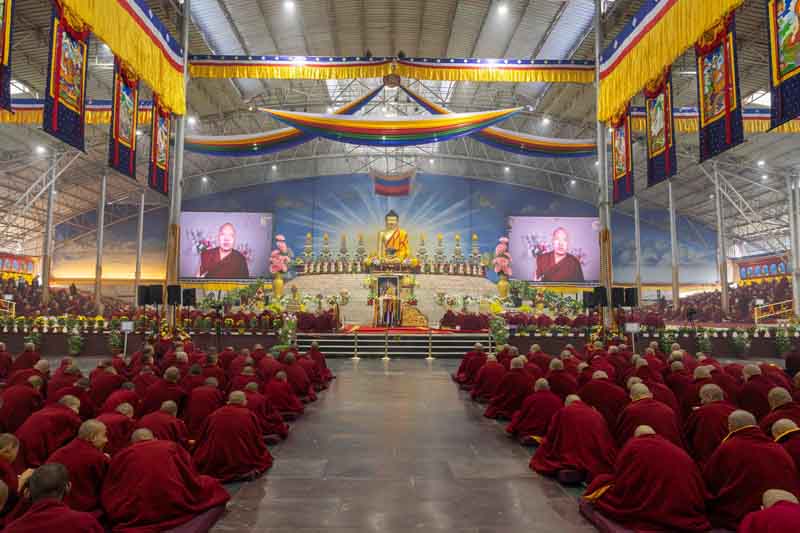
His Holiness Karmapa welcomed everyone to the fortieth Kagyu Monlam and offered greetings to all the Rinpoches, tulkus, monks, nuns, and all the faithful who had come from all over the world.
When considering the subject for the teaching, His Holiness decided it would be good to teach the dharma talks of Düsum Khyenpa. There were several reasons for this decision. First, during the pre-Monlam teachings, there was a celebration of the 832nd anniversary of Düsum Khyenpa’s parinirvana, so His Holiness wished to take the opportunity to teach some dharma connected to Düsum Khyenpa during the main part of the Monlam. The other reason he wished to teach on this subject is that many faithful people attend the Monlam, but they are not necessarily scholars, so it would be more beneficial to teach something helpful for the minds of beginners instead of advanced philosophy or research.
Our Kagyu forefathers had a particular way of teaching the dharma to ordinary people so that it would be easy to understand and helpful for everyday life. In fact, dharma talks are included in the collected works of many earlier Kagyu masters, and when we read these talks we can see that these teachers were able to bring out the essence of the sutras and tantras. These talks contain the pith instructions born of the experience and realization of these masters who reached the culmination of their practice, so these talks are full of blessings and many other wonderful features. Unfortunately, in later times, the custom of the Kagyu masters giving dharma talks was lost. We can see this fact when we look at the collected works of later Kagyu masters, which unfortunately do not include dharma talks. This change was a great loss for the Buddhist public, as great teachers were no longer providing basic introductions of the dharma. For this reason, His Holiness Karmapa wants to take this opportunity to discuss a dharma talk by Düsum Khyenpa.
A Brief Biography of Düsum Khyenpa
The specific talk that His Holiness will discuss is called “Six Things for Quickly Achieving Enlightenment.” The first words of the text state: “I prostrate to the precious lama. In the words of the precious master:”
When it says precious lama here, it is likely referring to Glorious Düsum Khyenpa. As you all know, he was the founder of this Karma Kagyu lineage and he was also the first holder of the Black Crown as the first Karmapa. As the eighth Karmapa Mikyö Dorje said:
The Buddha’s nirmanakaya Gampopa,
Master Gompa, who was inseparable from him,
The Lord of Secrets Jetsun Rechungpa,
Dechen Rolpa, Chammo, Sale,
Gya, Chapa, Patsap, Sharawa,
Sanakpa, Galo, Bairowa,
Aling and others are the hundred great siddhas he followed.
This quote explains that when Düsum Khyenpa was young, he went to central Tibet to study with the most well-known masters of philosophy including Lopon Tölung Gya Marwa, Chapa Chökyi Senge, Patsap Nyima Drak, and others, with whom he studied the sutra teachings in full. Then he spent six years meditating on the pith instructions of the Kadampa tradition with the great sages Sharawa and Naljorpa Sherap Dorje. Afterwards, he received empowerments, tantras, and pith instructions in tantra from Palchen Galo, the Sakya siddha Aseng, and others. Next he went to Daklha Gampo and met Je Gomtsul, whom he saw as White Tara. Je Gomtsul was a student of his uncle Gampopa. After his meeting with Je Gomtsul, Düsum Khyenpa thought, “If the nephew has such qualities as this, what must the guru be like?” He then spent a long time studying with Gampopa and his nephew.
At that time, Düsum Khyenpa, Barompa, Yazi Ngönpo, and Zimshi Gyalwa were all well-known for reaching a level of excellence in meditation. Düsum Khyenpa was fortunate to receive the complete pith instructions from Lord Gampopa, Rechungpa, Lingkawa Drigom Repa, Cham Lhenchik Kyepay Drönme, Tsema Namkha Saldron, and Getsul Punyi, all direct disciples of Milarepa. No one received more comprehensive instruction than Düsum Khyenpa.
During his lifetime, Düsum Khyenpa went to central Tibet twice. On the first trip, he spent about a decade studying and more than twelve years practicing meditation. As it says in his biography: “With discipline, listening, and contemplation, / He engaged in meditation.” He thus reached the level of listening, contemplation, and meditation described in The Treasury of Abhidharma.
Gampopa had told Düsum Khyenpa to do his practice at Kamp Gangra, and that if he did so the benefit would spread throughout Ü, Tsang, and Kham. Following his teacher’s instructions, he went to Kampo Nenang to do his practice and later founded monasteries at Kampo Nenang, Karma Riling, Dopang Pun, Trekam Khyim, and in other places, thereby spreading the teachings of the Dakpo Kagyu in Kham.
Likewise, he had many student disciples. According to Karmapa Mikyö Dorje:
The Lion’s Roar of the Buddha was Düsum Khyenpa.
His sons were Drogon Sangye Rechen,
Yudrakpa, Tsangpa Kodrakpa,
Tishri Repa, the two Drika,
Napupa, Tsangpa Gyare,
Dampa Deshek, Sangye Yelwa,
Sangye Drampa, Lhopa Tamche Khyen.
Undisputed siddhi, these were your disciples.
The holders of the Dakpo Kagyu, who are like a golden mountain range, all held Düsum Khyenpa in great respect and esteem. He had many qualities of greatness.
Düsum Khyenpa’s Dharma Talk
Having provided a brief biography of Düsum Khyenpa, His Holiness Karmapa now turned his attention to discussing Düsum Khyenpa’s talk. This work states:
Those who wish to achieve unexcelled buddhahood in one lifetime and one body need to have six things, it is said:
Faith, prajna, compassion,
Meeting the lama, requesting Dharma,
And effort in accomplishing its purpose.
Here, Lord of Dharma Düsum Khyenpa is saying that there are six special resources, or conditions, that we require to reach the unexcelled level of Buddhahood. As the great beings of the past have said: “Being under others’ control is always suffering; controlling yourself is always happiness.”
It means here that happiness is when you have control over your body and mind. But if other people or circumstances prevent you from having freedom of your body and mind, that is suffering. Perhaps right now, you feel good mentally and physically. In this case, there is some temporary happiness, but of course these circumstances can change in an instant. For example, you might feel good in the morning but bad in the evening. As such, it is clear we do not have any real control. Without such control, we do not have true happiness and there is the chance that suffering might arise at any moment.
As long as we are in samsara, we are under the control of karma and the afflictions. Even if we achieve a body in the higher realms as a human or a god, that is not lasting happiness. The best kind of happiness, the kind of happiness that lasts, is when we are truly free from the control of karma and the afflictions. This liberation is the only true happiness.
You might wonder if it would be enough for you to achieve this kind of liberation for yourself alone. It is not enough. Right now, it is Christmastime and the New Year’s holiday is coming up. During this holiday period, people gather with their friends and relatives; they have a nice meal and enjoy themselves. Imagine that during the festivities, the house catches on fire. If a person completely forgets about their family and friends and runs away to save their own life, it is not right. Similarly, it is not enough for us alone to merely achieve self-liberation. There are many other beings who are also suffering because they are under the control of karma and the afflictions. We need to be friends to them in their times of hardship, in their times of sorrow. We need to continue to work hard to free every one of them from samsara. This behavior is the conduct of a bodhisattva.
When we achieve perfect buddhahood, we will be able to benefit infinite sentient beings. To achieve this level, we need six conditions to be met, as described above. Again, these six conditions are: 1) faith, 2) prajna, 3) compassion, 4) meeting a true guru, 5) receiving teachings from them, and 6) practicing the meaning of those teachings.
The First Condition: Faith
Regarding faith, Düsum Khyenpa states in his dharma talk:
Among these, faith is important at the beginning:
Good qualities will not arise
In people who do not have faith,
Just as green shoots will never grow
From seeds that fire has burnt.
This explains the many detriments of lacking faith. As far as the benefits of faith, from The Summary of All Trainings:
After stabilizing the root, faith,
Fix your mind on enlightenment.
It is explained to be the root of all traits that are good qualities.
The ultimate of the self-arisen
Is realized only through faith.
Those with no eyes can never see
The brilliant orb of the sun.
As this says, the ultimate nature, the unborn meaning, can only be realized by those who have superior faith. From The Gandavyuha Sutra:
Faith is the treasure, the jewel, and the best foot.
Like a hand, it is the basis for gathering virtue.
It guards and develops every quality.
Faith comes first; it is like a mother giving birth.
Faith makes the tree of enlightenment grow.
I have often explained this properly to the lay people in the area.
Among the six conditions, it is very important to have faith at the beginning of your dharma journey. Perhaps we might think it is most important to follow a guru and receive teachings, but this is not the case. There are many reasons why it is most important to have faith first.
For example, if you do not first have faith in the guru, then you will not follow the guru and you will not request the teachings from him or her. Even if you go through the motions of following the guru and requesting the teachings but you do not give rise to genuine faith, your mind will be unable to become the dharma. And if your mind does not become the dharma, then any action you do – whether listening, contemplation, and meditation or teaching, debate, and writing – these will all be pseudo-dharma and not true dharma. For this reason, the Buddha said:
Good qualities will not arise
In people who do not have faith,
Just as green shoots will never grow
From seeds that fire has burnt.
Without faith, you can never develop any good, virtuous qualities at all.
With regard to the benefit of having faith, Düsum Khyenpa quotes Shantideva’s The Summary of Trainings: “After stabilizing the root, faith / Fix your mind on enlightenment.” Once you have developed a stable faith in the three jewels, you will have a stable wish to achieve liberation. As Gampopa said in his Dharma Talks Called Excellent Auspiciousness:
The foundation or root of all dharma is faith—faith in the completely perfect buddha, faith in the dharma he taught, and faith in the sangha that practices that. When you have such faith, you will always go for refuge to the three jewels.
We often say that the difference between Buddhists and non-Buddhists is the practice of refuge. The only thing required for the practice of refuge is the presence of faith; if you have faith, it is enough, but if you do not have faith, there is no way you will be able to go for refuge. As Düsum Khyenpa states when quoting the Sublime Continuum:
The ultimate of the self-arisen
Is realized only through faith.
Those with no eyes can never see
The brilliant orb of the sun.
As this says, the ultimate nature, the unborn meaning, can only be realized by those who have superior faith.
We can take the four noble truths as an example to better understand why faith is required to realize the ultimate nature of the unborn meaning. The Buddha taught these truths are real, yet you might not be able to actually realize their truth just yet. But if you have faith in the Buddha’s teachings and believe that what he taught is true and valuable, you will nevertheless keep thinking about the four noble truths and turning them over in your mind. Then when the circumstances are right, you will be able to realize their meaning. But if you do not have faith, you will not believe what the Buddha taught and you will not spend any time thinking about his teachings. Non-Buddhists do not have faith in the Buddha’s teachings, so even if they hear the words describing the four noble truths, it is impossible that they will gain any certainty in them. Thus, the possibility for realization and understanding all comes down to whether or not one has faith.
In Tibet, there are illiterate older people who certainly cannot compare to Buddhist scholars in terms of their education. Yet because they have faith, they are able to develop a profound understanding of emptiness and Mahamudra. The only reason they are able to have this realization is because of their faith. In particular, the meaning of topics like emptiness, Dzogchen, and Mahamudra are beyond the understanding of any ordinary being anyway. It is hardly possible for us to get any understanding at all, let alone true realization. But if we think deep in our hearts that the teachings on these subjects are true and if we pray to realize their meanings just like all the buddhas, bodhisattvas, and lineage gurus, then one day we will be able to realize them. In particular, in Lord Gampopa’s tradition of the sutra Mahamudra, there are no empowerments, deity meditations, or trainings in the channels, prāṇas (Tib: རླུང) and bindus (Tib.ཐིག་ལེ). Instead, it is through the guru’s compassion that we attain realization. And whether or not we receive the blessings of the guru depends primarily on our faith and devotion.
Peace in Uncertain Times
Of course, having faith is a requirement for realization, and it also brings a number of benefits into our daily lives. First, if we have faith and belief, then we are able to find mental peace even when confronting uncertain situations. In our lives, there are so many things we cannot control – we may become ill, lose our job, break up with a lover, become estranged from family members, and much more. Situations often arise that are beyond our control. At those times, if we have faith and we rely on it, we can find some peace of mind even within the turmoil. For example, if a person has faith in the Three Jewels or even if they believe in the local deities and spirits, they will have a point of view that there is an ultimate order and greater meaning within the universe. Their view will not be limited to a worldly way of thinking. This kind of faith can help reduce suffering when we experience injustice or at the moment of death. It gives us hope and is something that we can rely upon.
Nowadays, some Tibetan brothers and sisters feel that faith and trust are old-fashioned and backwards and that these beliefs are superstitious and pointless. In some respects, such a view is true. Yet nevertheless, it is also true that having faith gives us a greater capacity and courage to confront dangers and changes in life. It is like when a person believes that gold has value and that its price will rise. In such a case, that person will do whatever he can to buy gold. In actuality, gold is just a type of metal. But because that person believes in the value of gold, he will pay a lot of money and bring all his skills and energy to bear to acquire more gold.
As another example, if a businessperson has faith in her future business plans and business partners, then she will invest capital and energy in her business even though the future is in fact uncertain. In ancient times, many merchants boarded ships and crossed huge oceans. They had no maps of the world and had no idea where they were going. The ships did not have engines but only sails, and they could only go where the wind took them. It was very dangerous, but still the merchants persevered and were not upset by the difficulties because they had faith their enterprises would be successful.
In short, if you believe in your profession and your aspirations, that faith will give you the courage to explore new paths and to innovate. So, faith and trust are not only helpful for bringing about peace when we must face uncertainty, but these qualities also give us the courage to even embrace uncertainty and explore new paths.
Motivation to Begin New Tasks
Another benefit of having faith and conviction is that it gives us the motivation to begin new activities. The future is unknown, and everything is impermanent and always changing. As such, we have no way to know for sure what will happen. We may be able to put together a plan, but without certainty of the results, it can be daunting to move forward with it. Faith gives us the power to begin.
For example, if you want to find a new friend or life partner, you must first gain trust in that person before committing to him or her. This person to whom you may make a commitment must prove themselves to be honest, straightforward, and reliable; they must be someone who will bring benefit to your life. You will look for someone who has a similar temperament as yourself and with whom you are compatible. At the start of a new relationship, trust is the most important component. If trust is present, the desire to form a relationship naturally arises.
As another example, many of us have spent many years at school and university studying to become scholars. The reason we do this is because we hope it will allow us to lead good lives and to have good livelihoods. We hope that all of our work and education will set us up for a bright future. We go through all this effort because we have this hope. In this way, faith and trust at the start of a task give us the impetus to actually begin the work.
Finding Meaning in Suffering
Finally, faith also gives us a way to extract meaning from suffering. In life, we experience difficulties and suffering that we cannot change. We may lose someone we love, suffer a defeat, or become ill ourselves. At a time like this, logic and reasoning are often not much comfort. We may wonder, “Why did this happen to me?” or “Why did this happen only to me?” But if we have faith and trust, we can shift our perspective about what is occurring. We may not be able to change the outer circumstances, but we can consider if there is some “special meaning” or if we can use it as a training to improve ourselves. We have the ability to change our thinking in this way. Doing so will not immediately eliminate the suffering, but it can prevent the total collapse of one’s mental state and the loss of all hope.
For example, when many older Tibetans experience suffering, they see it as an obstacle to their dharma practice that is testing them; this view encourages them to find ways to remove or transform the obstacle. Moreover, they also see the occurrence of obstacles as a good sign that they are on the right path. They know that without obstacles, they will not be inspired to become free from samsara. Thus, when obstacles occur, they see an opportunity to practice with increased diligence and mental strength. They may even recognize suffering as a result of previously accumulated negative karma, and this becomes an incentive to do even more practice such as Vajrasattva meditation and mantras or the Akshobhya dhāraṇī. For people with this mindset, obstacles do not cause them to lose heart or become discouraged, but rather they energize their practice.
Another example comes from the Austrian psychiatrist Viktor Frankl. Frankl lived in the time of Hitler’s Nazi regime during World War II, and Frankl and his family were put into a concentration camp. Most of his family including his wife and parents died there, but he survived because of a practice he developed called logotherapy. He explains his approach in his book Man’s Search for Meaning. Although the conditions in the concentration camps were absolutely terrible and it was a miserable situation, some people were able to survive. As Frankl explains in his book: “It was a peculiarity of the prisoners who survived the camps that they were able to maintain their inner strength by having a purpose, a meaning, to their lives.”
Those who survived the concentration camps were not necessarily the strongest people, but instead they were the ones who did not lose heart. Even in the midst of horror, they believed their lives still held a meaning and a purpose. Frankl believed that if a person feels their life has a special meaning, which often comes about due to faith in a religion or some commitment, they are less likely to become discouraged and are more able to endure suffering and difficulty. Frankl also famously said: “Those who know ‘why’ they are living can bear almost any ‘how’.” Having a purpose gives someone a unique strength to survive.
Another of his famous quotes is: “Everything can be taken from a man but one thing: the last of the human freedoms—to choose one's attitude in any given set of circumstances, to choose one’s own way.” You have a choice about the path you are going to follow, and no one can take that from you. No matter what environment, pressures, or society we find ourselves in, we still have freedom if we have faith. But if we do not have conviction in anything, then we have lost our freedom. With it, no one can defeat or destroy us. Even if you are experiencing great suffering, such as an incurable illness or complete failure and defeat, you can still believe that there is meaning in it. But once you see it as meaningless, you may fall into emptiness and become depressed or even suicidal.
Frankl predicted in the mid-twentieth century that people in modern society would continue to lose meaning in their lives. He saw traditional values being forgotten and he worried that people would be unable to find a new purpose and reason for living, and that they would subsequently fall into mental emptiness and be directionless. He said that the loss of meaning in life is not only an individual mental disorder but the fundamental illness of our entire era.
Having faith and conviction, and having a belief that there is meaning in this life, is something that has great practical value in our everyday lives. Having faith is not just about being superstitious or being religious, but it is essential for living a meaningful life.