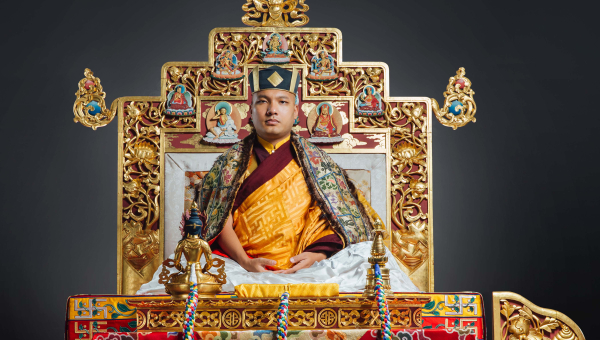
17th Gyalwang Karmapa's
Teachings -- The Fivefold Mahamudra
December
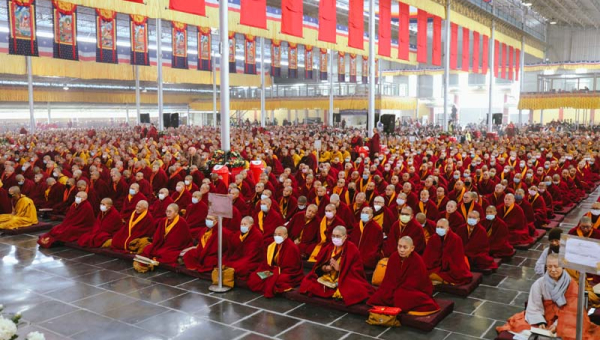
19–21, 2007, 7 PM at Tergar Monastery, Bodhgaya , India
. Translated by Ringu Tulku Rinpoche & Karma Choephel
For
the next three evenings, we will have a brief teaching
on the Fivefold Mahamudra.
Bodhgaya is a place where, for whatever reason, the
conditions are not all that good, and wherever you look,
everything is just empty, isn’t it? So when I come here
to teach the Dharma and look at all of you, it’s like it
is empty. My mind is emptied. When I get to Bodhgaya, I
don’t have much time to do a lot of preparation, so I
will just tell you whatever comes to mind. Maybe this
will be less fabricated or forced. Who knows, maybe it
will even be better for you.
This evening I will be teaching you the Fivefold
Mahamudra. The first verse is:
If on the steed of love and compassion, you aren’t first
Across the finish line of helping others,
The crowd of humans and gods won’t celebrate,
So apply yourself wholeheartedly to this preliminary.
If I explain the meaning of the words first, it will
probably help you understand it better.
In Tibetan poetry, there is a tradition of using
comparisons—metaphors and similes. Here we have a
metaphor where one thing is compared to another, and the
main point here is that love and compassion are
described as the preliminary. So here the meaning is
love and compassion, and the metaphor for them is a
steed, a horse.
This horse is not at all like one in your horse races
abroad. In our Tibetan horse races, the horses run all
out until they are practically dead, and then all you
get is a short white scarf. In your races you win lots
of things—gold medals and all that. But in Tibet, you
run all out and then all you get is a little white khata
scarf. So if you race in a horse race and win, then all
the people in the crowd will praise you.
In the same way, if you meditate on the bodhichitta of
helping others, if that meditation develops within you,
the gods and humans will praise you, saying, “That’s
great.” That’s what this is saying.
As for the meaning, we talk about many different
preliminaries. You all know these, like the precious
human body, death and impermanence, and karma, cause,
and result. There are lots of preliminaries. You all
know that. But the one we are talking about here is
loving-kindness and compassion. Why is that? It’s
because loving-kindness and compassion are what is
indispensable in the Mahayana. Loving-kindness and
compassion are the root of bodhichitta. That is why
loving-kindness and compassion are taught as the main
preliminary here.
The metaphor here is a horse race. We are not racing on
an actual horse, but on the horse of bodhichitta. Other
horses cannot keep up with this horse, and the main
point is that you must practice like that. When we
Tibetans talk about practice, we say that if you want to
practice really well, you need to practice so that a
hundred dogs could not catch you. Even if you are being
chased by a pack of a hundred dogs, they couldn’t chase
you down. That is how you should practice.
We need to do our practice as fast as possible. There
are problems and difficulties, but we need to be able to
get to our practice before they do. We need to be like
someone who is being chased by a hundred dogs, but they
can’t get him.
There are two main points here. The first teaches the
extent to which we need to practice, and the second is
that we need to get other sentient beings to rejoice for
us. Everything I am saying tonight comes down to these
two points.
The first point is the extent of loving-kindness and
compassion. Everyone knows what we mean by
loving-kindness: it is the wish that all sentient beings
be happy. Compassion is the wish that all sentient
beings be free of suffering. When we say that
loving-kindness and compassion should be directed toward
all sentient beings, it does not mean that love and
compassion must always be directed toward all sentient
beings. It does not mean that wanting a particular
individual being to be happy and free from suffering is
not love and compassion. The extent to which we need to
practice is until love and compassion are directed
toward all sentient beings, but wishing for an
individual sentient being to be happy and free of
suffering can also be loving-kindness and compassion, I
think.
Sometimes when we are meditating on loving-kindness and
compassion, if we are thinking about a big group of
people without seeing them as individuals, we just say,
“May everyone be happy!” That is easy. For example, when
we think about a lot of people, such as all the people
in this hall, it is easy to think, “May they all be
happy.” That’s just thinking in a general way. However,
when we pick out one individual and try to meditate on
love and compassion for him or her, that is something
different.
You should really think about it beforehand, otherwise
when you think you are meditating on love and compassion
for everyone and say, “May all be happy,” you don’t
really know whether that thought is genuine or not. So
beginners should begin by testing themselves with one
person and seeing what the extent of their love and
compassion is for that one person. If we don’t do that,
and instead think from the beginning that we love
everyone, that has no substance. Meditating toward
everyone is like air, which fills everything but does
not have much substance. Then, when you get to
meditating on an individual, you’d have second thoughts.
There’s the danger this could happen to you.
I have thought of an analogy. If we bought a huge piece
of fabric in Gaya and covered everyone’s heads with it,
that would be easy. We’d just put it on top of everyone,
and there would be no problem of it fitting. But if we
took the fabric, cut it up, and made each and every
person a hat, then there would be many different-sized
heads to account for. We’d have to make the hats smaller
for some and larger for others so they’d fit each
person’s head. It would not be nearly as easy as just
covering everyone with the huge piece of fabric.
Similarly, if we just cover everyone with the huge
fabric of love and compassion, that’s easy. There
wouldn’t be so many lumps and bumps. But, like making
hats, considering each individual person is not all that
easy, so that is something we need to think through.
But if we need to think about each individual person,
how many are there? There are probably a thousand or two
here in this hall. If we need three or four days, or
even a week, to meditate on love and compassion for one
person, then meditating for a thousand people would end
up taking twenty or thirty years. How long would it take
to develop love and compassion for all sentient beings
throughout space? We don’t know.
So what should we do? Fortunately, there’s a way around
this. We can look at how people are similar and see what
they are like. Of course, there are many different types
of people, but we can think about them generally in
terms of the reasons we should have love and compassion
for them. If we look at one aspect, everyone wants to be
happy and free of suffering, so in that regard everyone
is the same. Of course everyone has their own character,
but when we think about one aspect and then really
recognize it in terms of one person, we can feel the
same way toward all the similar kinds of people.
For example, in Tibet, as you all know, we always talk
about our mothers in all the prayers we recite—“all
sentient beings, our mothers.” So the person whom
Tibetans first turn their eyes toward when they meditate
on love and compassion is their mother. A mother is
someone very special. Tibetans realize how kind their
own mothers are, and when they think a lot about that
and remember how kind she has been, they think that
everyone who is a mother must be good. If you do not
know a woman, and then someone says, “That is my
mother,” you feel differently about her than you did
before. When Tibetans hear that someone is a mother,
they consider her important, someone for whom we could
and should feel love and compassion. The reason this
feeling arises is that first we Tibetans recognize that
our own mother is someone for whom we should meditate on
love and compassion, and we have contemplated this a
lot. Because we identify her in this way, we can feel it
for others as well. That is why it is OK for us to think
of people in terms of how they are similar.
Our loving-kindness and compassion should not be
partial. We need to make them as vast as possible. But
like I said before, we need to be fast. It’s not enough
just to have love and compassion. It is not enough just
to have a kind heart in our practice. We need to develop
and increase it as much as we can, using our
intelligence and whatever experience we have.
However, there are many things that make obstacles for
us in developing loving-kindness and compassion. So in
order not to have many obstacles, we need to get there
first. Then when the obstacles come around tomorrow,
they’ll think, “Where’d they go? Where did the person I
was going to obstruct go?” We need to fool them. How do
we do that? We need to be faster than the obstacles; we
need to get to our practice before the obstacles arrive.
Even if we cannot confront them, we need to be able to
evade them. That is the second thing we need to think
about.
In general, how is it that we can quickly achieve the
results of our practice? When we want to get something,
we need to know what there is to get, and there must be
something to aim for. First of all, there has to be
something there. If there’s nothing there, we can’t get
anything. When we meditate on love and compassion, we
cannot merely meditate on love and compassion. We need
to know what we really want: where we are going and what
we are aiming for. If there is nothing to get, then you
have no aim, and there will be no result for you to
achieve, nothing at all. It is not just working hard at
the cause and practicing love and compassion. It is not
just wishing for a result. There has to actually be a
result to achieve. We need to think about what it is
that we need to achieve.
What we need to know is that from the very moment we
plant the seed or cause, the process that brings the
result has started; the result begins to ripen. In the
same way, once we begin practicing, the result also
begins to ripen. The result is not yet manifest, but we
have to have some idea of what the result will be. If we
practice without any thought of that, then there is the
danger that the practice we are doing will not serve any
purpose.
Sometimes we have something that we say is very
precious. Since it’s precious, we put it underground,
behind something, or in some high corner behind a book
or something. Then there’s the danger we won’t be able
to find it tomorrow. So when we practice, we might think
that the result is something “secret” that we should
keep hidden, an inconceivable result that we need to
keep secret. Take the example of omniscience. We do not
understand it, so when we are trying to achieve
omniscience, it is some big secret. We think omniscience
is some great thing, but we don’t comprehend it. We
don’t know what it is or what it is like. For that
reason we first need to recognize as clearly as possible
what the result is like. We need to know it and see it
for ourselves. The more we do that, the faster we will
get to the result. The more we think about the result,
and how the result is connected to the practice, the
faster our practice will be, and the fewer obstacles
there will be. If we don’t really know the connection
between the cause and the result, we may want to achieve
some good result, but it will be extremely difficult.
That is why it is so important for us to consider the
connection between cause and result.
This depends upon each of us. I won’t go into too much
detail, but the essence is that at first we should not
think about the things we can’t know, the things that
are inconceivable or difficult to get our minds around,
the big things like mahamudra or dzogchen. First of all,
think about the things we can know and comprehend. If we
do that, it will be easier for us to practice. The lamas
will also have less work. You don’t know this, you don’t
know that, and you ask millions of questions, but the
lama can’t explain everything. You use up all the time
you have with the lama. You end up getting farther and
farther away from your practice, which is rather
bizarre.
That is why we should first practice the things that we
can see, know, and experience. After that, we can come
to know the things that we did not know at first. After
learning one thing, we can learn another, and it
continues like that until omniscience: you know the
unknown, and what you know becomes omniscience. Because
the extent of what you know expands, there is
omniscience. Otherwise, if at first you don’t know
anything and think about achieving omniscience, it would
be really difficult. This teaches the framework of our
practice.
Next, we need to get others to feel happy and rejoice.
How can we do that? Should we tell jokes to make people
happy? Or should we have fun with them? We each have to
think this through. Our own kind heart alone does not
help. It does not help just to keep our kind thoughts
inside our chests: we need to show them. Loving-kindness
and compassion are about actually bringing benefit to
other people. If we think that love and compassion are
precious and valuable, like valuable jewels, and that we
need to keep them for ourselves, then this is not really
loving-kindness and compassion. Our love and compassion
should be like radiating lights, and they should radiate
as much as possible to help other beings.
How can we practice so that they do radiate? How can we
make others happy? How can we help others? We should not
merely have the loving and compassionate wish that
others be happy and free of suffering. We should free
them from suffering and make them happy. We should
express love and compassion through our body and speech
so that other people actually experience the results of
our actions. Otherwise, loving-kindness and compassion
are nothing special. For that reason, we need to get
others to rejoice. But don’t think that the reason for
getting others to rejoice is so that things turn out
well for me and that everyone will praise me. That’s not
it. Loving-kindness and compassion are something that
everyone needs. Everyone needs to have affection for one
another. We need to love and care for each other. So
there is nothing wrong with giving love.
There is a story. Was it in the time of the Dharma king
Songtsen Gampo? A pandita from India was having a
conversation or something, and then he cut open his
chest and showed the entire infinite mandala of the
deity. That’s the story. So we might say, “My love and
compassion are real love and compassion.” But if we cut
open our chest, we’ll just see our red heart, not love
and compassion. Love and compassion aren’t something you
can see in the flesh of someone’s chest. Where’s the
love and compassion? The heart going thump, thump, thump
isn’t love and compassion. If love and compassion are
inside us, no one can know about it or see it. But if we
show it on the outside through the bearing of our body
and speech, others will be able to see it.
It’s very important that we show it. If it’s just for
our own benefit, there’s not much need for love and
compassion. Love and compassion are for helping other
people. If we keep them for ourselves, it doesn’t matter
whether we have love and compassion. You might as well
then just save your money, get rich, and have some fun.
The actual reason we need love and compassion is that we
need to think about the benefit of sentient beings, and
our actions should be for their benefit. If we can do
that, then our loving-kindness and compassion will not
be just words, but will become something really
authentic.
December 20, 2007, 7 PM
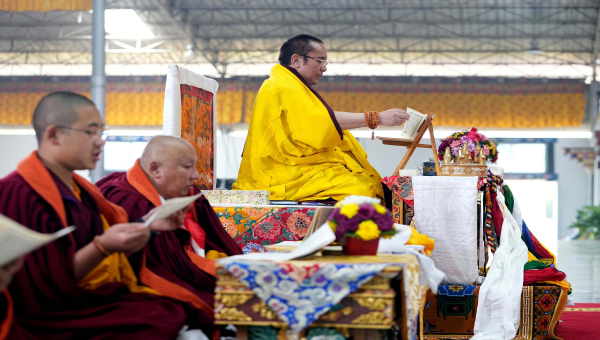
First of all, I would like to wish everyone tashi delek. This is the second
evening of the teaching, and I would like to greet everyone.
You all must speak Tibetan really well! Yesterday evening I taught you sim ja
nang. Today it’s tashi delek. I’ll think of something else for tomorrow.
I was able to teach here in Bodhgaya for the first time in 2003. I gave some
Dharma teachings in the basement of the Mahayana guesthouse. There weren’t many
windows in the basement, so there wasn’t much air. It was a bit difficult. But
there weren’t so many people then, so it was probably OK. Then there got to be
more and more people. Even though Mingyur Rinpoche built this large building, we
still have trouble fitting everyone.
I consider myself a student in my Dharma practice. I don’t feel I have come to a
level where I am a Dharma teacher, or, even if I have, I do not have much desire
to teach. This is because teaching Dharma is not just explaining; it brings a
responsibility, and I do not have any wish to just teach whenever and wherever.
But many people have come, and it seems like I ought to teach, so I will teach a
bit. The main thing is whether this helps you. That is my thought in teaching
you. I don’t think of myself as some big professor. I’m teaching whatever I can
to help you. I’m trying my best to teach you something that will help you.
Sometimes we Tibetans think in funny ways. We think that unless you can actually
help, there is not much benefit in just wishing to help. We think that unless
there is an actual benefit, the wish to help is pointless. But I think that in a
sense this is a mistake, because it’s not just about whether or not you benefit
others. We need people to want to help one another and to have affection for one
another. It’s not a question of whether or not it actually is beneficial. Merely
having affection for one another is very important and necessary.
Sometimes I think that while I am living on this earth, if by living this life I
can bring some actual benefit to the beings of this world and all those who are
connected with me, that would be wonderful, that would be best. Even if that
does not happen, I will continue to lead this life. I am living for the benefit
of the beings in the world, so that there will be one more person in this world
with love and concern for them. That is how I think. Sometimes I think I have to
do something extremely helpful, and I get attached to that. But I don’t know
whether things will turn out exactly as I want. If I can help, that would be
best. Perhaps my wish to help you might become one condition, even if only a
tiny one, that brings you happiness.
Now I will continue with the text. The main topic this evening is the second
instruction of the Fivefold Mahamudra:
If the king, your body, the yidam deity’s form,
Does not reign on the throne of unchanging ground,
The court of mother dakinis will not gather,
So apply yourself wholeheartedly to seeing your body as the yidam.
I will explain the words. You might not understand this otherwise.
“If the king, your body, the yidam deity’s form” uses the metaphor of a king, a
great and powerful king. Our aggregates and sense bases—form, feeling,
conception, and the others—are pure from the very beginning. They are naturally
pure. They are the yidam deity from the very beginning, already a buddha by
nature, as they are inherently free of all stains and faults. This is what the
king represents.
Our nature is the deity, but in terms of our ordinary perceptions, we cling to
what we perceive with our five senses as soon as it appears. We cling to it as
real and solid, concrete. Because of this clinging, the primordial nature of the
deity cannot become manifest. So in order to purify our ordinary concepts, we
meditate on the creation phase, which has the three characteristics of clear
appearance, stable pride, and recollection of purity. If we meditate on the
creation phase with these three characteristics, the “court of mother dakinis”
will gather. That is, we will gain mastery over all phenomena of samsara and
nirvana, or be able to know all phenomena of samsara and nirvana. We will be
able to see them all and reach the state of omniscience. We will be able to
enjoy that state, or enjoy such riches. That is the meaning. The metaphor is of
a king. Because the king reigns over his kingdom well, he gathers a large court.
His kingdom becomes vast.
Almost all of us here practice some sort of meditation on a yidam deity. This is
important. It is extremely important to have clear appearances of the creation
phase. I don’t have anything terribly deep to say about this. Sometimes we
Tibetans make easy things difficult. I will try to do the opposite. I thought I
would say a few things to make the difficult things easy.
Here there are two points: the creation phase with clarity, purity, and stable
pride, and gaining mastery over samsara and nirvana. There are these two parts.
The first is meditation, and the second is its result. What is the result we
need to achieve? It is gaining mastery over samsara and nirvana. These are the
two points. The first is the creation phase with clarity, purity, and stable
pride.
“Clarity” means that the creation phase should have a clear appearance. The
appearances of the deity’s body color, ornaments, and clothing should all be
clear.
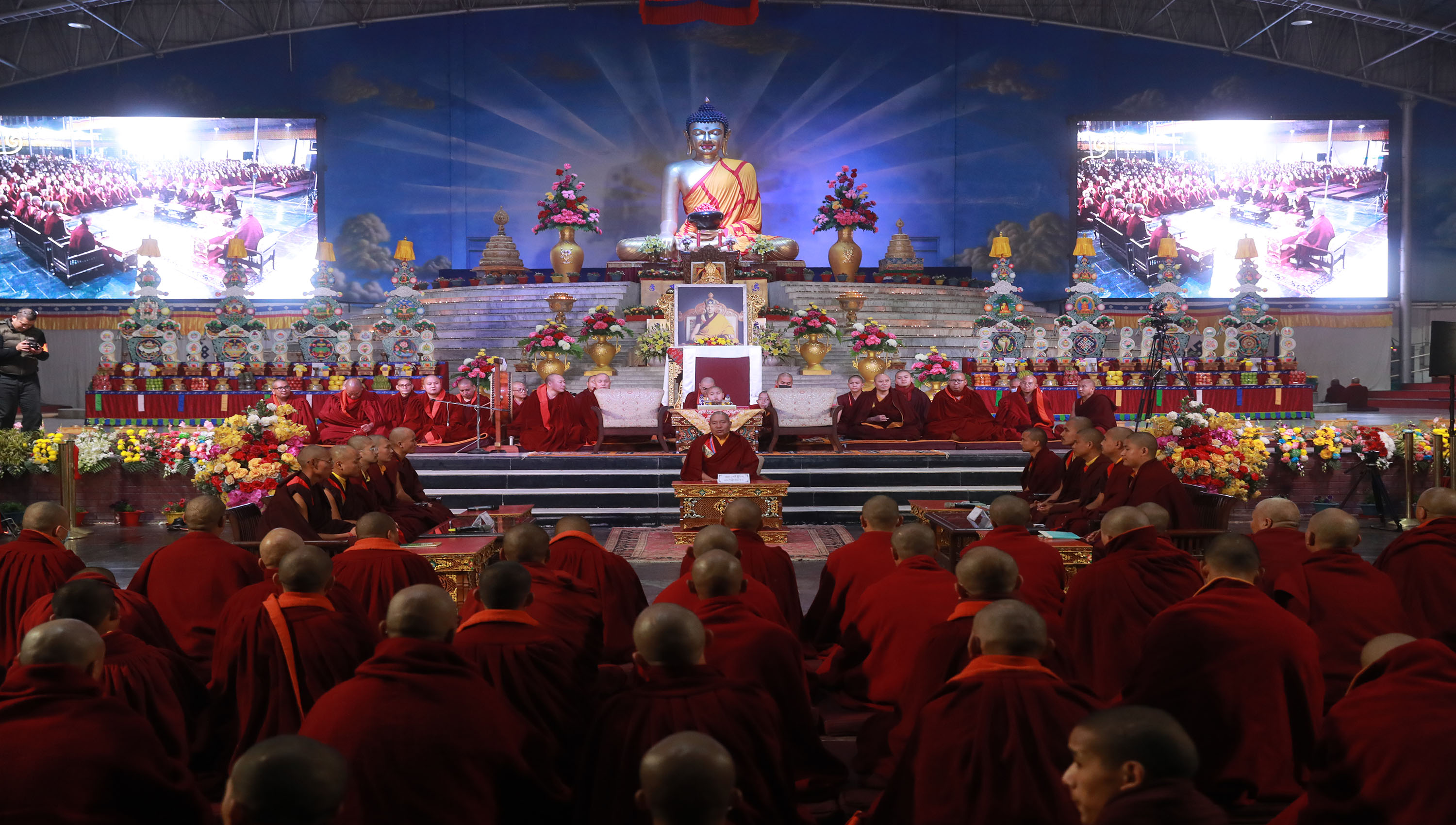
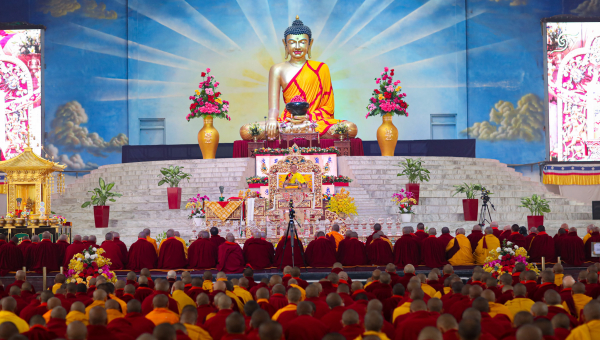
For example, behind me there is the statue of our Teacher, the Buddha
Shakyamuni. This is a nirmanakaya form, a monastic form. This form is easy. When
you meditate on something, first you have to know what it is. But if you have to
meditate on another deity, such as Vajrasattva or Vajradhara, drawn in the
Tibetan style, first you have to study the painting. You have to have some
knowledge of the Tibetan style and shape of the jewelry or ornaments beforehand.
Every artist draws these slightly differently, and the faces are completely
different, so which one is it? Sometimes this is a real problem.
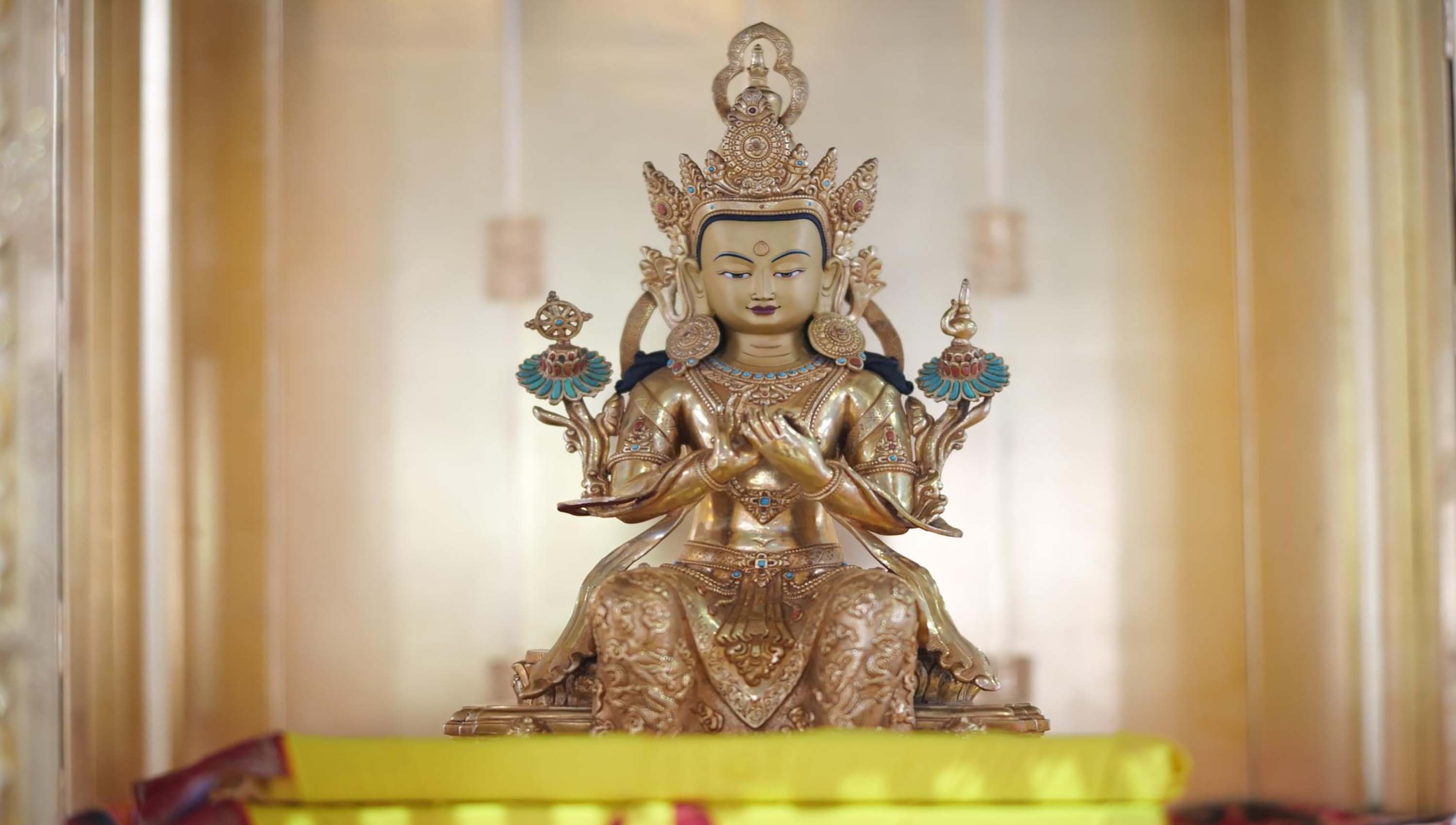
What is Vajradhara like? How should you meditate on Vajradhara? What are
Vajradhara’s ornaments really like? If you want to meditate on these clearly,
you have to really think about what they are like. For instance, if you meditate
on your clothes, you have to be familiar with them. If you look at your own
jewelry, you know what its shape is and what unusual features it has. You need
your visualization to be this familiar. You are visualizing yourself as the
deity, so it would be strange to visualize yourself wearing ornaments that you
know nothing about. You’d think, What is this? For you foreigners who have never
seen Tibetan jewelry, it is difficult. You need to think about this.
I used to think that there was a certain way that the yidam deity had to look.
Although the color and implements might differ, the form was supposed to be a
certain way. However, these days there is no way for us to figure out how the
deity should look. Long ago in Tibet, when they first made a depiction of Green
Tara, they were not sure what she should look like. They talked it over, and
they had a general idea of Tara, but finally they ended up taking the most
beautiful Tibetan girl and using her as a model. That is the story. They had no
choice. Who knows what Tara looks like? Even lamas who actually see the deities
see them with slightly different colors or implements; sometimes even the faces
are different. So it is difficult to say what they are actually like.
So how should you meditate? When you are meditating on deities, if you feel as
if you absolutely must visualize them exactly as they look in thangkas, then you
are just visualizing them as pictures, and it becomes difficult to visualize
them as living, breathing beings. You need to visualize them as living people,
so first you should think about a person. Think about a good-looking person,
whoever that might be. If you think in that way, it is probably OK. But you have
to think carefully.
Don’t get the idea you can think about any good-looking person. You should not
think about some blond Western guy or girl; most bodhisattvas have black hair, I
suppose. Be careful on this one.
You need to know that there really is someone like this. Then you’ll be OK. And
you don’t have to visualize the precious ornaments exactly as they are in a
thangka. These days we see a lot of different kinds of ornaments. Decide which
ornaments the deity is wearing. You can’t just visualize whichever ornaments you
happen to think about, but if you think about it a bit and decide for yourself
that they are probably like this, it will be easier to see, and I think it will
be more like seeing a living person.
If we are going to meditate on Tara, for example, first we have to know the
characteristics of her body, ornaments, and robes. Then we need to be able to
draw a picture in our minds. We should not look at someone else’s picture and
meditate. We need to be able to paint Tara’s entire figure in our minds. If we
can do that, then it will be easy from the beginning. If instead we just look at
someone else’s picture, it is really difficult. We don’t know anything about
Tara, so there’s no way we can practice. That would be just watching a show, not
practicing. In the beginning, middle, and end, practice should be something that
arises from within our mind-stream. Tara should not be someone we are looking
out at, as if in a picture or a movie. We should draw a clear picture of Tara in
our minds. That is very important.
Sometimes it is said that when we are actually meditating, first we should
visualize each part clearly, one at a time, but that is a little difficult. For
example, when we picture someone we know well, it is really difficult to
remember all the details clearly. If instead we remember a general, overall
picture of the person, that is easier. If we try to picture each detail, it
won’t feel like a living being.
Sometimes I think it’s funny. When you first think about the characteristics of
Tara, for example, she is gorgeous, with white skin and long, black, shiny hair.
So someone might consider himself or herself really beautiful and think, “If I
just visualize myself, that would be fine. Isn’t my skin really fair? Isn’t my
hair really nice? Aren’t I beautiful?” So they visualize themselves. This might
happen. But in any case, first of all our visualization has to have all the
characteristics that make Tara different from other deities. We need to know all
these, and only then we can think of her. Whether or not the visualization comes
as clearly as we would like, at first Tara does not appear in our minds, so we
need to make her appear in our minds. We feel her presence. We need to think she
is there, whether or not we see everything.
For example, sometimes when we are not good at the creation phase, Tara’s head
might be missing. Sometimes when we don’t know how to think about it, we only
see half of her. Maybe we can meditate on Tara’s upper body really well, but the
lower body isn’t really there; it is not very clear. Or sometimes we have the
difficulty that the upper body is not very clear. In any case, take it
gradually. Take it from the beginning. It will not be exactly perfect at first.
When we do practice, it comes gradually. If it had to be perfect from the
beginning, we would have had to be buddhas already. That would be bizarre! So we
need to go step by step.
After that there is gaining mastery over samsara and nirvana. There’s no need to
talk about that right now. We can talk about mastery over samsara and nirvana
later, when we get there. Maybe we cannot master them yet.
The third point is this:
If the sun of your devotion does not shine
On the snow mountain of the lama’s four kayas,
The streams of blessing will not flow,
So apply yourself wholeheartedly to developing devotion.
I will explain this briefly. The metaphor for the lama, who is in essence the
four kayas, is a snow mountain. The metaphor for praying to the lama with
devotion is the sun. The blessings that come from praying to the lama with
devotion are compared to the streams that flow down a snow mountain because of
the sunshine.
This is a really good metaphor. Some students have such intense devotion that
when the sun of their devotion shines, it makes the lamas sweat buckets. The
students show so much devotion that the lama sweats.
Before, in Tibet, there were the snow mountains and glaciers, and only when the
sun shone would any streams start to flow. Nowadays, with global warming, we
don’t need to wait for the sun to shine. So bring on the global warming of
devotion!
I don’t really have much to say about this. When I say you should have devotion
for a lama, it does not sound good, because I am called a lama, and you are
students. You should decide for yourselves whether you need devotion. Whether
devotion happens is something between the student and the lama, an authentic
lama. But mainly it is a practice on the student’s part. You need to think about
this for yourselves—whether or not your lama is authentic, whether or not you
need devotion. If you need to have devotion, you should think about how to do it
for yourselves. I don’t have any particular suggestions about how you should
develop devotion.
If you really have devotion, faith, and trust, then you should not really need
much of a reason. You should not need to analyze. Naturally, when you see the
qualities of the lama’s presence, or see the way the lama’s activity manifests,
your perception could be transformed. That is what devotion does: it carries
your mind along. Devotion is the shortest way to quickly realize the ultimate
nature. If it could be found in a few words or verbal explanations, then
everyone would realize the essence of the dharma nature. But this is not
something you can find in words. It is primarily a question of whether you have
transformed the deluded appearances in your mind. It depends upon whether your
mind has been carried along by devotion. So let your mind be carried! I can only
offer my hopes and prayers.
December 21, 2007, 7 PM
First of all, I would like to
offer you all my greetings. This will be the last teaching on the Fivefold
Mahamudra, and we have two more points to discuss: the actual practice of
mahamudra and how to make dedications.
We have now come to the fourth stanza, which discusses the actual practice of
mahamudra:
If in the expansive sky of the mind essence
The cloud banks of your thoughts do not disperse,
The stars of the two wisdoms won’t shine bright,
So apply yourself wholeheartedly to nonconceptuality.
First I will explain the words.
The “mind essence” is the nature of mind—emptiness. The metaphor for the nature
of mind is the sky. Even though the nature of mind is naturally pure, it is
covered by stains that obscure it. If we do not purify these stains, the
naturally present qualities, such as the two wisdoms of knowing the nature of
all things and knowing their variety, cannot become manifest. This is like when
the clouds in the sky have not dispersed and the bright light of the stars is
not visible.
This discusses the essence of mahamudra practice—what we rest in during actual
practice. However, today we are just giving an explanation, so we do not need to
rest in meditation.
This is talking about the mind essence, the nature of the mind. Every individual
thing has its own particular features, and it also has aspects that are common
to other things. The particular feature of the mind is that it is naturally
clear and aware. That is the particular feature of mind that is different from
other things. But the nature of mind does not exist on its own, it is not
something real, and it cannot be defined in a concrete way. This is similar to
the nature of all things, which also do not exist on their own, are not
something real, and cannot be defined in a concrete way. If we look at it in
terms of this aspect of their natures, all things are by nature similar, or by
nature the same.
The emptiness of the mind and the emptiness of all things are the same. Their
natures are the same, not separate. For that reason, if we realize the emptiness
of our minds, which is closest to us, we will be able to realize the emptiness
of all things. This is because they come down to the same thing. They are not
different. They are the same.
But what do “not being something real” and “emptiness” really mean? What are the
emptiness of the mind and the emptiness of all things like? There are
instructions on looking for the mind, such as looking to see what color it is,
whether it has a form, where it stays, where it goes, or where it comes from.
When we look for where the mind comes from, where it stays, and where it goes,
we don’t find it, and we think, “That is emptiness. That is what emptiness is
like.” But that is just our mental picture of emptiness. This is emptiness that
comes out of thinking things over. When something comes from thinking things
over, there is something to hold on to. We cannot think without something to
hold on to. Making something that does not have anything to hold on to into
something that does can only come from conceptualizing and fabricating. It is
not unaltered, genuine experience. At first, we are really holding on to
something. Then we try very hard to make that into nothing to hold on to. It
would be difficult to say that this fabricated concept of nothing to hold on to
is emptiness.
What I really think is that the moment anything exists, it does not exist on its
own. The moment anything appears, it does not exist on its own. Although there
is the appearance, the appearance itself does not exist on its own. This does
not depend upon whether or not we analyze it. The appearance itself does not
exist on its own from the moment it appears. If we can realize this, we have
probably arrived at emptiness.
Usually we first have to develop an understanding of emptiness. First we have to
say, “Emptiness is something like this.” Then we have to try to make it
emptiness, but it is really difficult to have that happen. For example, if we
have a box or something that we need to empty, we first have to take all the
things out, which is a lot of work. Then when it has been emptied, we think,
“This is empty.” Generally, whether the box is filled with things or not, it has
space—I am not talking about emptiness—inside it. But we do not know how to make
use of this space when it is already filled. In order to use it, we first have
to make the box empty. Only then do we think there is space.
Of course we need to gain an understanding, but actual emptiness is really just
that things do not exist on their own from the moment they appear. Emptiness
does not depend upon our looking for it or making something up with our minds.
Even if we realize that things lack inherent existence the moment they appear,
this does not stop them from appearing. There is no need for you to stop
appearances. You do not have to establish emptiness. The moment something
appears, you see it as emptiness. The moment you see something as emptiness, it
is an appearance. It is a mere appearance; it does not inherently exist. This is
what I mean by the phrase “things do not exist on their own from the moment they
appear.”
When we talk about emptiness, you might think that we cannot perceive emptiness
unless we dispel the external appearances of conventional phenomena. That is not
correct. Perceiving emptiness does not depend upon dispelling appearances. We
grasp at things as real. We grasp at them as having characteristics and as
inherently existing. From the moment something appears, we grab it and use it
right away. There’s no thought first of what it might be. It immediately appears
to us as if we can take it in our hands. This happens through the power of
ignorance. But actually, whether we turn our attention toward emptiness does not
depend upon whether we dispel all the external conventional phenomena that
appear. It only depends upon whether we stop our mental grasping at things as
real. That becomes something that helps us perceive the emptiness of relative
things; the appearance is not a hindrance to realizing emptiness.
It is like this toy called a Mirage Hologram Generator you can get abroad. There
is a saucer on the bottom, and a space inside. You put a flower or something
inside, and cover it with a second glass bowl, and a 3D image of the flower
appears above it. The flower is inside, not on top, but its image appears on
top. You might think you want to grab it, but there is nothing to grab.
In brief, the supreme achievement of mahamudra is to have an unaltered
experience. We get closer to how things really are. For us, when we have
something in mind, our minds cannot accommodate emptiness, and when we have
emptiness in mind, our minds cannot accommodate anything. But the way things of
the world really are can accommodate things, and it can also accommodate
emptiness. How is that? Without altering anything, you just rest naturally in
it. Of course we are always within the nature, but because we make things up
with our minds, we are not able to rest without altering. For that reason, the
unaltered naturalness does not fit in our minds.
It is said that what we really have to depend upon to develop the unaltered
experience of mahamudra is the lama’s blessing. So first we need to have
authentic lamas who hold the mahamudra lineage and can give us the blessings to
realize mahamudra. We need to follow individuals who possess these
characteristics. When we follow them, they will say, “This is what mahamudra
is.” At that point we need great confidence. We really need to have confidence.
When we have confidence, there is no particular need to alter anything. When we
just have confidence in something, it is as if it is unaltered. Once we begin to
think about it, it is altered.
The feeling of confidence to say, “It is so. It is so” happens because of being
able to rest in the natural state. There are many kinds of confidence, but this
is confidence that the nature of things is so. It is so. First you look to see
how things really are. Once you see what it is like, then whatever happens, you
can say, “It is so.” Then you can rest within that. Whether the lama teaches
mahamudra as it is or whether he teaches it slightly incorrectly, since he has
blessing, when you think, “It is so,” there is the power of that confidence and
devotion. Even if we do not make progress through the power of the lama, we can
make progress through our confidence and devotion. Even if the lama is not able
to teach the words and meaning exactly correctly and there are some minor
mistakes, when our own confidence and the lama’s blessings combine, I think that
the meaning can dawn within our beings. The subject of mahamudra is so.
Now for the final stanza:
If you don’t polish the wish-fulfilling jewel
Of merit and wisdom with your aspirations,
It won’t give the results you need and want,
So apply yourself wholeheartedly to making dedications.
Because of doing virtuous things, we have a beautiful jewel. If we do not clean
and polish this jewel, and instead just leave it alone, it will get covered by
so much dust from outside that eventually you will not even be able to see it.
This attractive jewel is there in the middle of the dust, and we need to polish
it so that it becomes stainless. Similarly, if the beautiful wish-fulfilling
jewel of whatever virtue we have done is encrusted with selfish intentions,
self-centeredness, and self-cherishing, it will not have any brilliance at all.
If instead you take it out and show it to people, from that point it will be
beautiful and stainless and give people joy. If you have a valuable thing and
display it to everyone, it will become famous and turn out well. But if you keep
it to yourself, only you will know about it—others will not. Therefore, in order
to bring about the temporary and ultimate benefits for ourselves and others, we
need to dedicate any seeds of virtue so that all sentient beings throughout
space, our mothers, may attain buddhahood.
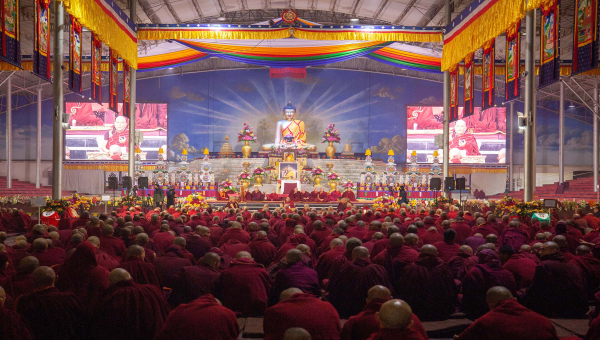
I am very happy that you all have come to the Kagyu Monlam and gathered here
this evening. So I would like to thank you all from the bottom of my heart.
When I look out at all of you, many of you are looking up with smiling, happy,
excited faces. This is what my eyes see, and I pray that in the future I may
always be able to see your smiling, happy, excited faces just like this.
I am participating in the Kagyu Monlam with you, and for my own part, I dedicate
all the merit and virtue I have gathered to you and all sentient beings
throughout space, and I pray that you may easily attain all your temporary and
ultimate wishes.
We are approaching a new year, and I would like to extend my best wishes for the
new year. We are awaiting the new year with new hopes. As I have said before, in
the new year, I hope even more than before to be able to fulfill the wishes of
all of you who have trust in me. Most of you have traveled here from foreign
countries, and many of you are my friends and acquaintances. I often think of
you. My prayer is that in the new year, all of us friends may meet in many
different places. That is my New Year’s wish. So I wish everyone Happy New Year.
Now I have to teach you something new in Tibetan. Sarva mangalam!